 Afield
Choose the question before choosing the channel
A founder can write more posts without getting closer to a buyer. The useful starting point is a question narrow enough to investigate: which team experiences this problem, what does it do today and what would make a different approach worth trying?
Give Afield your product website and one audience. For the worked example here, the product helps customer-success teams manage client implementations. That excludes employee onboarding, which shares the word “onboarding” but belongs to a different buyer and workflow.
Research how customer-success teams handle changing task owners
during B2B client onboarding. Find public discussions and relevant
company examples. Exclude employee onboarding. For each source,
show the task, the difficulty and what remains unknown.
Open the original discussions. A complaint about duplicated checklists suggests an explanation about reusable templates. A complaint about ownership suggests an assignment example. Neither tells you what someone will pay. Use public discussion research to prepare the next question.
A campaign brief you can put to work
Illustrative campaign brief. This fictional SaaS product supports reusable task templates and customer-specific owners. The example is a writing assignment, not reported buyer research or a claim about Afield's own feature set.
| Decision | Brief |
|---|---|
| Reader | Customer-success managers running repeatable implementations for B2B clients. |
| Question | How do we reuse an implementation checklist when the owner changes for every customer? |
| One deliverable | A tutorial showing one reusable task and its customer-specific assignment. |
| Example to show | Template task: “Confirm data export.” Account owner: Mira. Completion: customer confirms which export they can provide. |
| Necessary product input | A permitted capture or tested example showing where the actual product stores those three values. |
| Reader's next action | Bring one existing checklist and identify the first task whose owner changes by customer. |
| Follow-up signal | A reader asks about their own checklist or supplies a concrete implementation exception. |
In Afield, keep this brief with the research and ask for the full tutorial. If the first draft skips the assignment example, request that section directly; you do not need another strategy document.
Choose the first campaign asset from the evidence
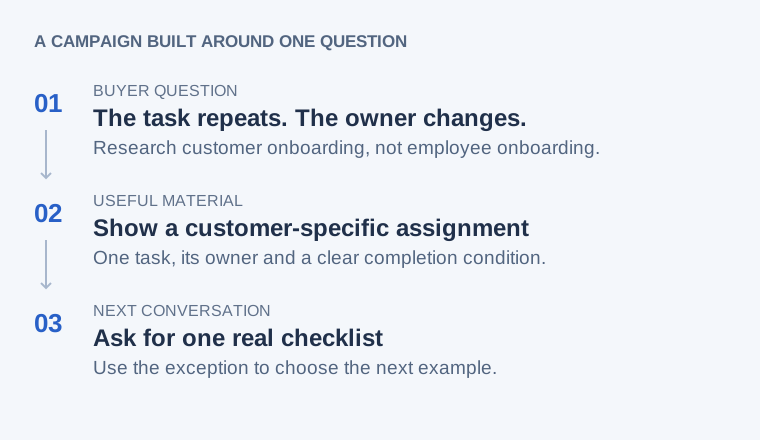
Keep the first assignment small enough to review against the product. Ask Afield for the complete tutorial using your tested example, then identify the passage where the reader can actually assign an owner. If that passage needs a feature the product lacks, change the proposed solution before writing the outreach.
From the same material, prepare a short post explaining one step and an individual message offering the worked example. The three-channel drafting example shows how the reader’s next action changes the format. Reusing the evidence does not mean pasting an identical paragraph everywhere.
Write the opening around the example
Here is the complete opening for that demonstration tutorial:
Reuse the task. Assign the owner for each customer.
“Confirm data export” belongs in the implementation template. Mira belongs on one customer's implementation. Separating those two choices lets the team reuse the checklist without assuming the same person owns every account.
Start with one task. Record the action, the owner for this customer and what counts as complete. For the export task, completion means the customer has confirmed which export they can provide—not simply that someone sent a reminder.
This gives the writer a specific promise to fulfil in the rest of the page. It also gives outreach a small offer: “Would a worked example of customer-specific checklist ownership help your team?”
Use Afield's content workflow to develop the article and email separately. Bring the next buyer question into the weekly plan, so the next assignment follows what you learned.
Decide what the response changes
After sharing through a channel you approve, record what happened at each stage. A completed article shows that you produced the asset. A reader supplying their own checklist gives you a concrete case to investigate. A request for a demo changes the next task to preparation for that conversation.
| Observed response | Useful next task |
|---|---|
| “Our owner changes after the first meeting.” | Extend the tutorial with the handoff, using a real supported product workflow. |
| “Can this work with our existing checklist?” | Ask for a permitted example and prepare a specific walkthrough. |
| No recorded replies | Check the sent message, recipient fit and delivery evidence before changing the whole positioning. |
Use the weekly GTM plan to choose the next experiment. Afield can carry research into content, replies and review; you still need your actual product evidence and the buyer’s response to decide which offer to pursue.
Begin with the first research-and-email walkthrough, or inspect the complete capability directory before selecting another task.