 Afield
In this article
Keep one fact sheet, then give each channel a different job. An email can ask a recipient about their own process, a social post can make one observation and an article can show the procedure.
The source packet
Demo: the research note and drafts below are fictional editorial examples. They are not customer findings or published messages.
Material: Three sample sales-to-implementation handoffs
Finding: Two do not name an owner for the customer's required export
Unknown: Whether the missing owner delayed either project
Suggested action: Record the input, its owner and the acceptance check
Boundary: An owner cannot produce a file they do not have permission to export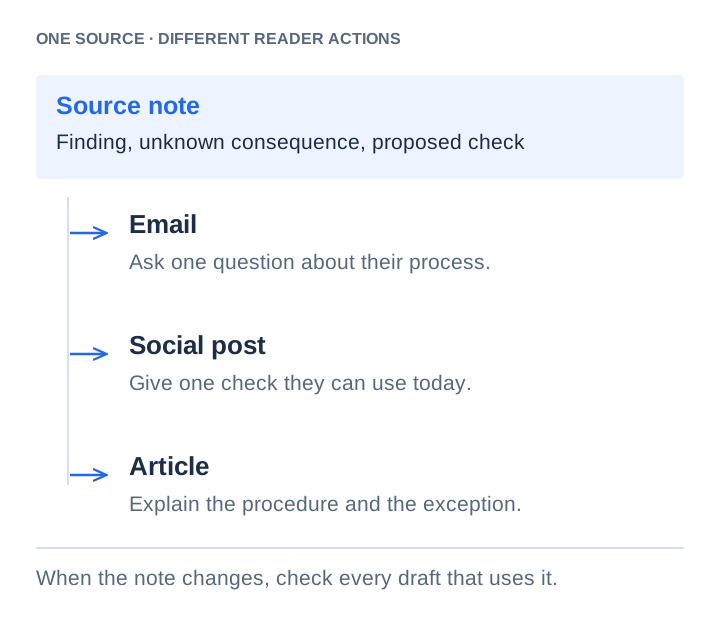
Assign the packet a version and keep the draft locations beside it. For this exercise, call it handoff-note-v1. If a second writer joins the work, they should be able to distinguish the observed sample, the unknown consequence and the proposed practice without searching through earlier messages.
The unknown consequence is the most important boundary. Two missing owners do not prove a delay, lost revenue or widespread operational failure. None of the drafts below needs that claim to be useful: they can show readers how to inspect their own handoff.
Email: ask about the recipient’s handoff
Subject: Who owns the export before kickoff?
Hello Morgan,
I’m putting together a short checklist for the handoff from sales to implementation. One question it covers is who owns the customer export needed before kickoff.
In your team, does sales confirm that person before the handoff, or does the implementation owner find them afterward? I’d be interested in the route you use when the contact cannot access the export.
Thanks,
Avery
Social post: give readers a small check
Try this on your next sales-to-implementation handoff: find the first input you need from the customer. Can you name both the person supplying it and the person checking it?
“Customer to send export” leaves both jobs open. “Morgan supplies the export; Priya checks the date range and required columns” gives the next person something they can act on.
If Morgan cannot access the file, record who can. A named owner helps only when the handoff also explains what happens at that exception.
Short article: include the exception
Before kickoff, assign the input and its acceptance check
A handoff can name a project owner and still leave the first customer input unowned. “Customer to send export” does not identify who can obtain the file or who will decide it is usable.
Write one line for the required input. For example: “Morgan supplies the account export by Tuesday. Priya checks that it covers the agreed period and contains the required account identifiers.” Keep the file location beside that line so a teammate covering the project can find it.
Ask Morgan to confirm access before accepting the date. If another team controls the export, identify that team’s contact and update the handoff. If the file cannot be supplied, Priya should record whether kickoff can proceed with a smaller agreed scope or needs to move. Leave that decision with the project owner.
At kickoff, check the actual file against the acceptance line. Marking the input “received” is insufficient when the file covers the wrong period. Keep the correction and its owner visible until the input can be used.
What changes between the three versions
| Version | The reader’s next action | Editorial choice |
|---|---|---|
| Answer one question about their own process. | Do not paste the entire procedure into the opening message. Give enough context to make the question intelligible. | |
| Social post | Check one handoff they already have. | Keep the example self-contained, including the exception that makes it useful. |
| Article | Use the procedure with a colleague. | Name both owners, the acceptance check and what happens if access is unavailable. |
This is why simply trimming the article to fit each channel often produces three weak versions. An email does not need a miniature introduction, conclusion and full checklist. A procedural article does need the details that make the instruction executable.
The article version can also supply a line readers can paste into a project record:
Input: Account export for the agreed date range
Supplier: Morgan — access confirmed before accepting the due date
Reviewer: Priya — checks period and required account identifiers
File location: [approved shared location]
Exception: If access is unavailable, name the authorized supplier
Decision owner: [project owner] confirms scope change or revised kickoff
The bracketed fields are intentionally blank. Filling them with plausible names or a guessed file path would make the example look finished while leaving the real handoff unusable.
Keep corrections synchronized
If a later check changes the source note from two missing owners to one, change any draft that uses that count. The three drafts above avoid making a prevalence claim; their shared fact is the structure of the handoff question. Save the source packet beside the drafts using a source ledger, and include the intended audience and product limits in the writing brief.