 Afield
In this article
Two replies from ten emails can contain useful information. Calling the campaign a winner or a failure throws away most of it. Read the replies first, then decide what the next small run should change.
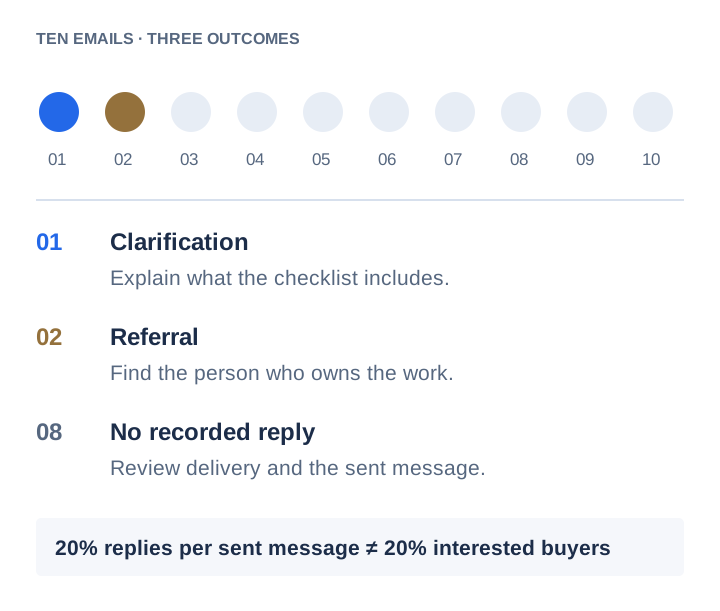
Define the batch before calculating a rate
Write down the send window and the review cutoff. If the first five messages have had seven days to receive a reply and the last five went out this morning, a single percentage conceals different observation periods. Keep that fact in the review rather than pretending every recipient had the same opportunity to respond.
Count people or accounts consistently. Three replies in one conversation are not three responding recipients. A bounce belongs in the delivery record; an out-of-office message is different from a human response. Preserve the raw categories even if your summary later combines some of them.
In the example below, the denominator is ten sent messages to ten recipients, not ten proven deliveries. That is why the result is called replies per sent message. If your system confirms nine deliveries and one bounce, you may also calculate replies per confirmed delivery, but label the different denominator.
The one-page review
All messages and counts below are fictional, for demonstrating a review. The offer is a sample data-import checklist.
| Item | Recorded result |
|---|---|
| Activity | 10 individual emails sent with the same checklist offer. |
| Replies | 2: one asks what the checklist includes; one redirects the sender to an implementation colleague. |
| No recorded reply | 8 at the review date. Delivery and reading are not established for these records. |
| What we learned | The offer needs a clearer description; at least one selected contact did not own the work. |
| What we did not learn | Whether the audience generally wants the offer, or why the eight people did not respond. |
| Next action | Answer the first question, follow the referral and tighten the contact-role rule for the next ten accounts. |
The observed reply rate is 2/10, or 20%, for this sample and review date. It is not a forecast for the next batch. Neither reply establishes a sale.
Reply one: the offer is unclear
“Is this a product demo, or a checklist our administrator can use?”
A useful answer supplies the distinction immediately:
It’s a checklist your administrator can use. It covers required fields, sample comparisons, duplicates, rejected rows and who approves the import. I can send the sheet without a demo. Would you prefer the blank version or one filled with an example?
Add that concrete scope to the next email. Do not rewrite the campaign around a discount when the actual question concerns the deliverable.
Reply two: the wrong owner
“Our implementation lead handles this, not customer success.”
Reply: “Thanks—would you be comfortable introducing me, or should I use the public team contact?” Record the role correction. Do not treat a referral as permission to invent the colleague’s address.
Keep a record that explains the number
| Recipient record | Observed outcome | Next action |
|---|---|---|
| 01 | Asked whether the offer is a demo or an administrator’s checklist. | Send the scope clarification; record whether the requested format is accepted. |
| 02 | Referred the work to an implementation lead. | Ask for an introduction or use a verified public contact route. |
| 03–10 | No recorded human reply by the review cutoff. | Check delivery information and the sent version before deciding on a follow-up. |
Use the ten-record review sheet to keep each outcome separate. Its rows reproduce this illustrative batch; replace them with your records. The sheet does not label either reply as “qualified” because neither has yet established interest in a buying conversation.
One additional reply would move this batch from 20% to 30%; one fewer would move it to 10%. That arithmetic is enough to show why an exact-looking rate can be a fragile basis for a decision. The words in the responses are more useful here than a league table against a broad industry average.
The next ten emails
Keep the offer and company criteria steady. Select people whose published roles include implementation, and describe the checklist in one sentence. Record that both the contact rule and the description changed, so you do not later attribute a difference to only one of them.
For the eight silent records, first inspect any delivery failures and the exact sent messages. If you cannot establish delivery, preserve the uncertainty. Silence alone does not tell you to change the price, abandon the audience or increase the volume.
Before the next run, write a stop condition. For example: pause if the saved list contains another excluded business type, if messages go to unverified recipients, or if the same unclear promise survives review. These are observable process failures. “Keep going until the response rate improves” does not tell the operator what to do when the underlying list is wrong.
Also record what would justify continuing: a recipient accepts the requested checklist, a referral reaches the actual owner, or a reply identifies a concrete obstacle the offer can address. These are proposed decision criteria, not outcomes already achieved by this example.
At the next review, bring the sent versions, replies and updated role notes together. The decision is whether another small run is worthwhile and what question it will answer.