 Afield
In this article
Your impressions doubled. Clicks barely moved. The obvious reaction is to rewrite the title, publish another article or ask why the SEO work is not converting. Each could be the right action. None follows from that chart alone.
The first question is smaller: did the page become less attractive to the same audience, or did Google start showing it to a different audience? Those situations need different edits. If you confuse them, you can spend a week improving a page for readers who were never likely to buy.
This walkthrough uses one fictional customer-onboarding software company and a complete sample dataset. The numbers are deliberately small enough to check by hand. They are not Afield customer results. The aim is to leave the review with a specific editorial decision, rather than another dashboard summary.
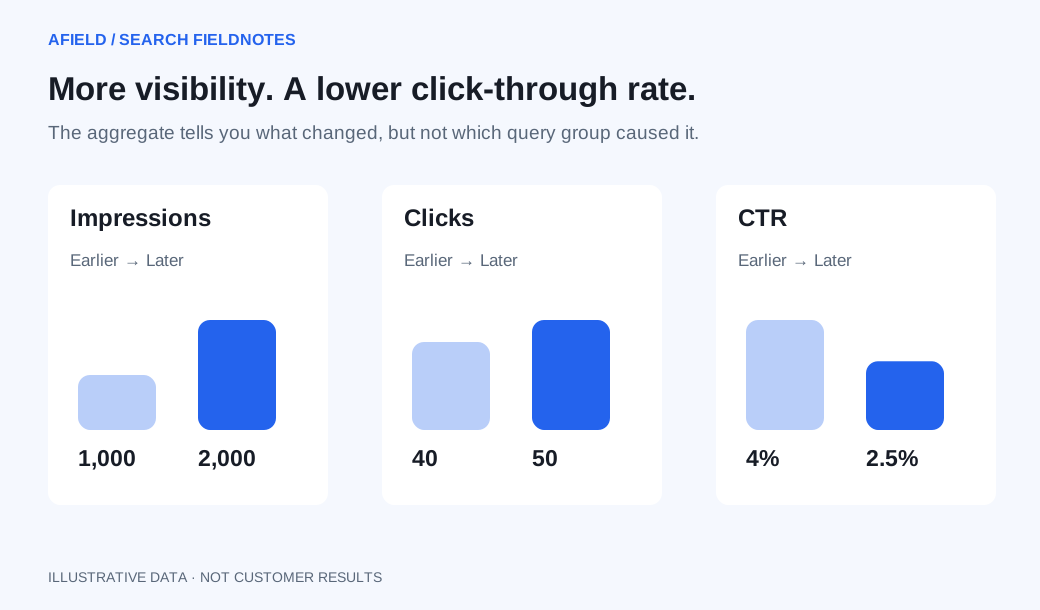
Read the denominator before judging the headline
Imagine the company has a page about migrating customer-onboarding templates. Over two comparable periods, it moves from 1,000 impressions and 40 clicks to 2,000 impressions and 50 clicks. CTR falls from 4% to 2.5%: a decrease of 1.5 percentage points, or 37.5% relative to the earlier rate. Clicks, meanwhile, increase by 25%.
Both descriptions are mathematically correct. “CTR collapsed” and “traffic grew” could therefore describe the same page. Neither tells the editor whether the article is helping the intended buyer. That is why a review should retain the counts alongside the percentages.
Google defines CTR as clicks divided by impressions. Average position is an aggregate across impressions, not a fixed rank every visitor sees. Use those definitions when reading the report; do not interpret an average position as a stable spot on one universal results page. Google’s definitions of impressions, clicks and position.
For this review, assume both periods cover four complete weeks, use the same search type and refer to the same page. These are comparison choices, not a mandatory waiting period. A page with very little activity may need a longer window before small movements are useful.
Split queries by the problem the reader is trying to solve
The sample page appears for two broad kinds of search. One concerns moving customer-onboarding templates between systems. The other concerns general checklists. An editor needs to distinguish them because only the first group clearly matches the article’s intended task.
| Query group | Earlier impressions | Earlier clicks | Later impressions | Later clicks |
|---|---|---|---|---|
| Specific migration searches | 800 | 36 | 800 | 36 |
| Broad checklist searches | 200 | 4 | 1,200 | 14 |
| Total | 1,000 | 40 | 2,000 | 50 |
The specific group has not deteriorated: its impressions, clicks and CTR are unchanged. The broad group supplies all the extra visibility. Its clicks increase, but not as quickly as its impressions.
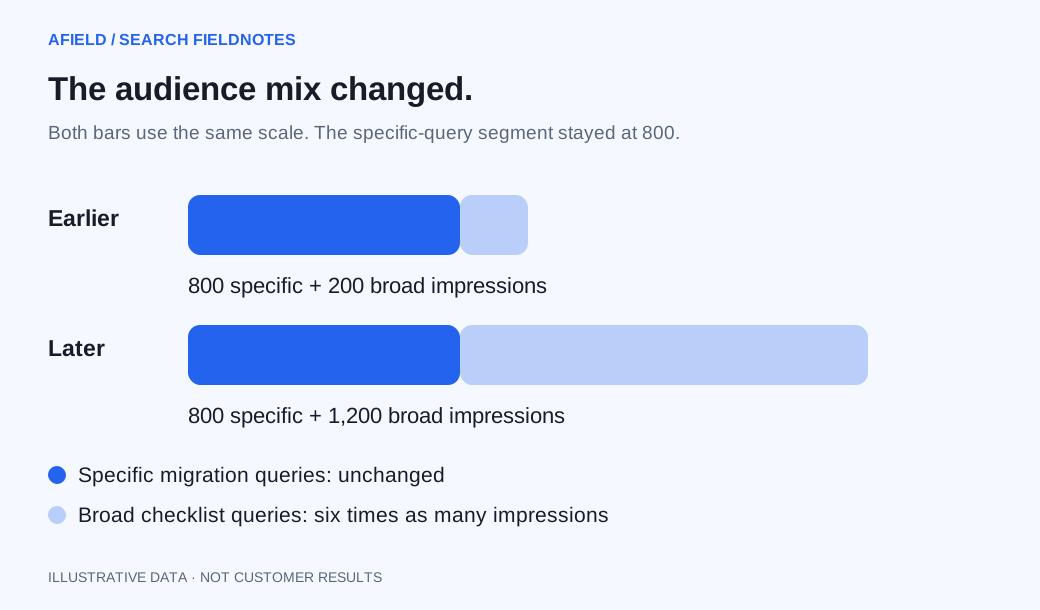
In a real export, grouping takes judgment. “Employee onboarding checklist” belongs in a different bucket from “customer implementation template migration.” A shared word does not establish a shared buyer. Keep ambiguous phrases in an unresolved group instead of forcing them into the segment that supports your preferred conclusion.
This example is intentionally a complete two-group dataset. In an actual report, do not assume the displayed query rows account for every impression. Keep the page total next to your reviewed rows and record any remainder. A tidy spreadsheet is not a reason to invent the missing queries.
A quick way to check your grouping
Write one sentence describing what each group wants, without mentioning your product. For example: “Move existing customer implementation templates without losing ownership or due dates.” If the sentence becomes “Learn everything about onboarding,” the group is probably too broad to guide an edit.
Inspect a few phrases on each side of the grouping rule. Save those examples with the analysis. Another editor should be able to tell why a query was included, and move it if the interpretation was wrong.
Work out how much of the CTR change comes from the mix
The specific group’s CTR remains 36 ÷ 800 = 4.5%. The broad group falls from 4 ÷ 200 = 2% to 14 ÷ 1,200 ≈ 1.17%. So there are two changes: the broad group performs differently, and it makes up much more of the total.
A simple diagnostic is to apply the later group rates to the earlier impression shares. Keeping the earlier 80/20 mix gives 0.8 × 4.5% + 0.2 × 1.17% ≈ 3.83%. That is close to the earlier 4%, and well above the actual later 2.5%.
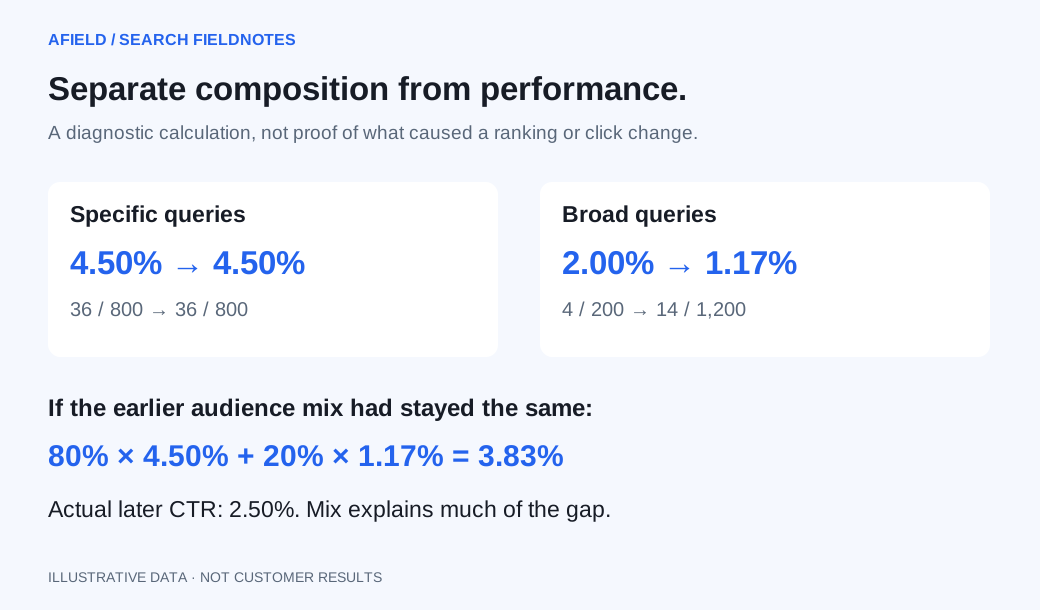
Under this particular decomposition, changing the group rates at the old weights accounts for about 0.17 percentage points of the decline. Changing to the later weights accounts for the remaining approximately 1.33 points. The allocation depends on the order used; treat it as a way to inspect the numbers, not a uniquely determined causal attribution.
The practical conclusion is narrow: the aggregate decline is not evidence that the specific migration answer stopped working. We still need to investigate the broad queries. Changes in position, result presentation, devices or the queries within that group could explain its lower rate. The calculation cannot choose among those explanations.
Decide whether the new audience deserves an edit
Open the broad group and read the searches. Suppose most are about employee onboarding. The company sells software for customer implementation. Rewriting the page around HR checklists might win irrelevant clicks while making its purpose less clear. In this case, leave the specific migration answer intact and avoid commissioning a new HR article merely to pursue impressions.
Now consider a different finding: the broad queries mostly concern importing old customer checklists. That is relevant. The existing page may discuss migration in general but omit the field-mapping example readers need. Here, the useful change is a worked mapping section, not a longer introduction about the importance of onboarding.
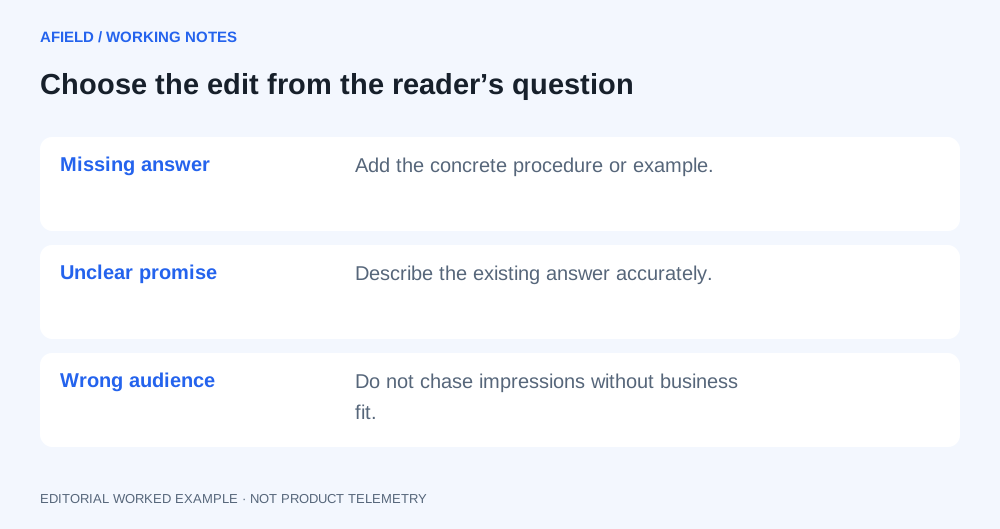
Use the following distinction in the editorial brief:
- Relevant question, missing answer: add the missing procedure or example to the appropriate page.
- Relevant question, answer already present: inspect whether the title and opening describe that answer clearly, and examine other changes in search performance.
- Different audience: establish a business reason to serve it before adding content.
These are editorial choices. They are not guarantees of higher rankings. The important output is a reason for changing one part of a page that another person can inspect.
Write the actual replacement, not “improve the content”
A vague issue creates a vague rewrite. “Make the article more useful and SEO-friendly” leaves the writer to invent the problem again. Specify what the reader needs to accomplish and which evidence supports that interpretation.
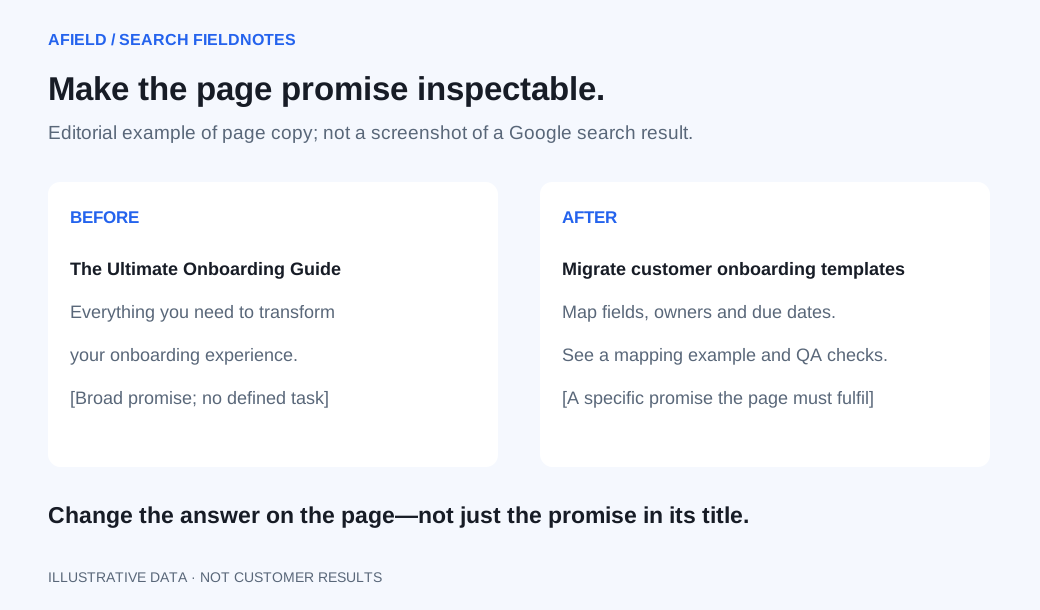
For the relevant-import scenario, a concrete brief would read: “Add a section showing how a customer implementation checklist transfers between systems. Include original fields, destination fields, information that cannot be transferred automatically and checks before using the imported template. Keep the existing page URL.”
The new section could contain this illustrative mapping:
| Existing field | Destination | Check before use |
|---|---|---|
| Task name | Task title | Confirm that meaningful detail was not truncated. |
| Owner email | Assigned owner | Resolve missing users; do not silently assign every task to the importer. |
| Days after kickoff | Relative due date | Confirm calendar versus working-day rules. |
| Dependency | Preceding task | Check that relationships survive a changed task order. |
This is a conceptual example, not documentation for a named import tool. A real product article should replace it with that product’s supported fields and a tested import. If a field requires manual work, say so in the procedure.
A suitable opening might be: “Before moving a customer onboarding template, map task ownership, relative deadlines and dependencies. Import one template first, resolve missing users and check the task order before copying the process to live customers.” That gives the reader a task and a starting point immediately.
The title should accurately describe the improved page. Google may generate its displayed title link using several page signals, so changing the HTML title does not guarantee the exact wording shown in search. Google’s title-link guidance.
Keep the review small enough to learn from
Record the original page, query group, date range and proposed explanation before publishing the edit. Keep a copy of the old section. If the title, body, URL and internal linking all change together, it becomes much harder to tell what the next review is actually evaluating.
That does not mean a team can never make several changes. It means the record should describe them honestly. “Added field-mapping section and revised title” is a useful note. “Optimised SEO” is not.
Example review note: We are testing whether the page answers import-related customer-onboarding questions clearly enough. We added a field map and validation procedure on 7 October. We kept the URL and existing migration sections. At the next review, compare the same relevant query group and inspect any measurable enquiries associated with this page.
Choose the next review window based on the traffic available and the decision at stake. With only a handful of clicks, a single visitor can move a rate substantially. Do not declare a winning title after one afternoon. Equally, do not postpone fixing a plainly missing or inaccurate answer while waiting for statistical certainty.
Review the relevant group first, then the page total. If the group gains clicks, retain the observation but check for other changes before crediting the edit. If clicks rise without useful downstream activity, investigate the offer and the next step on the page. If nothing moves, ask whether the original query interpretation was wrong before adding another thousand words.
The result of this exercise is a specific choice: keep the answer serving the existing audience, improve a missing answer for a relevant audience, or decline to chase an unrelated one. That is what the impressions chart cannot decide by itself.
About the examples: All charts and tables in this article use illustrative data or conceptual page copy. Metric definitions and title guidance are linked to Google’s documentation. The segmentation, calculations and editorial recommendations are this article’s worked analysis.