 Afield
In this article
Record the decision a buyer cannot make, then decide whether a page can help. “Migration concern” is too broad. “The operations lead cannot tell who must split contacts stored in one CSV cell” gives the writer a specific problem.
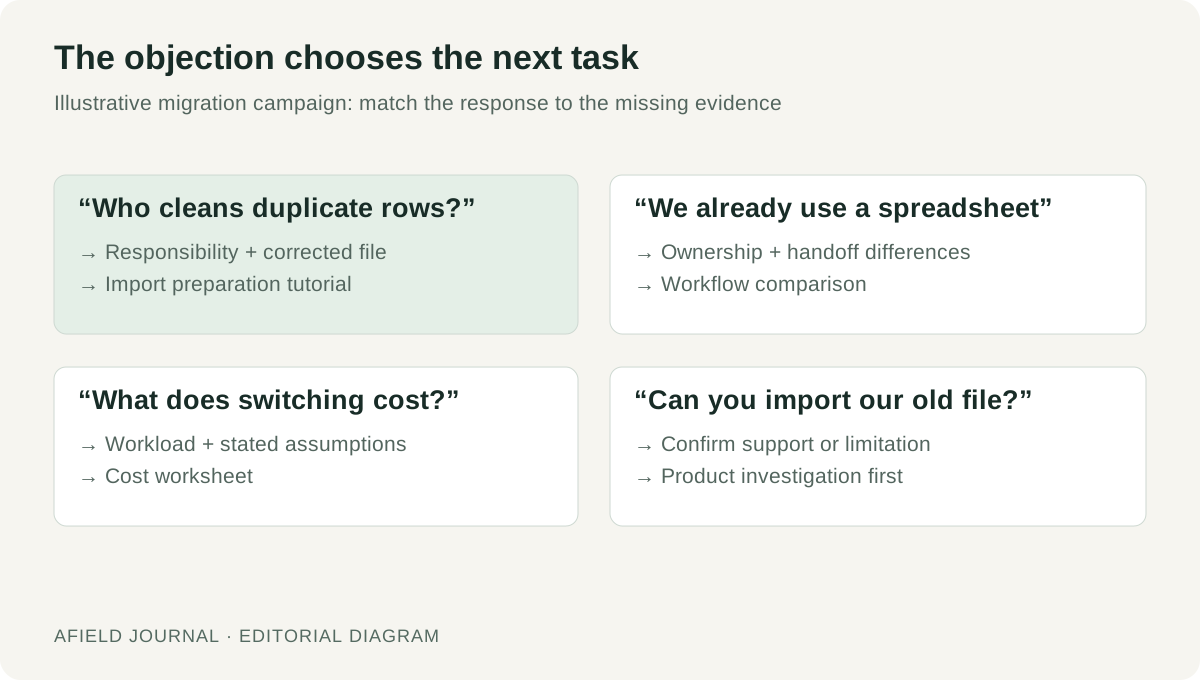
Sort the notes into a small backlog
Demo: this backlog uses fictional sales notes. Counts describe only the example conversations, not the prevalence of an objection in the market.
| Buyer question | Observed notes | Needed answer | Assignment |
|---|---|---|---|
| Who cleans our duplicate company rows? | 3 conversations; two source systems | Responsibility, stable identifiers and a corrected file. | Import preparation tutorial after implementation confirms the rules. |
| Why change from a spreadsheet? | 2 conversations | Show where assignment and handoffs differ. | A narrow task comparison, including when the spreadsheet is sufficient. |
| What does switching really cost? | 1 conversation | Software, setup, cleanup and review time under the same workload. | Cost worksheet. |
| Can you import our unsupported legacy file? | 1 conversation | An honest supported route or a confirmed limitation. | Product/delivery investigation before an article is commissioned. |
The migration brief a writer can start from
Reader: Operations lead preparing a trial
Question: Who resolves duplicate companies and contacts combined in one cell?
Deliverable: A short preparation tutorial with input and corrected CSV examples
Input required: Importer's supported fields and contact structure, confirmed by delivery owner
Example required: Two company rows sharing one identifier; preserve both contacts
Explain: Who does cleanup, what changes, and what must remain unresolved
Exclude: Promises to import formats the product does not support
Done when: Delivery owner reproduces the example and salesperson can answer the original question from the page
Give the writer the confirmed format before they create the sample. A plausible CSV is not useful documentation when it does not match the importer.
A complete opening that states the responsibility
Prepare the duplicate-company rows before importing. In this example, the operations lead owns the cleanup and the implementation team checks the sample before the full upload.
Keep the company’s stable identifier while resolving name variations. Preserve each contact in the importer’s supported structure. If two rows share an identifier but describe different operating entities, pause the merge and confirm the relationship; deleting one row could also delete a useful contact history.
Use that passage only when those responsibilities match the service being documented. Follow it immediately with the actual input file, correction and expected import result.
Close the assignment with the buyer’s question
Ask the salesperson to point to the passage they would send. If they still need to explain who cleans the file, the page is unfinished. If the buyer understands the instructions but cannot obtain an export from their old system, record that as the next obstacle rather than writing another import overview.
Place the finished answer beside the product or pricing passage that raises the concern; the link map shows how. For the spreadsheet objection, use a specific task comparison rather than a list of generic software benefits.