 Afield
In this article
Replacing a company name in a template is not meaningful personalization. The reader still has to figure out whether your offer has anything to do with their work.
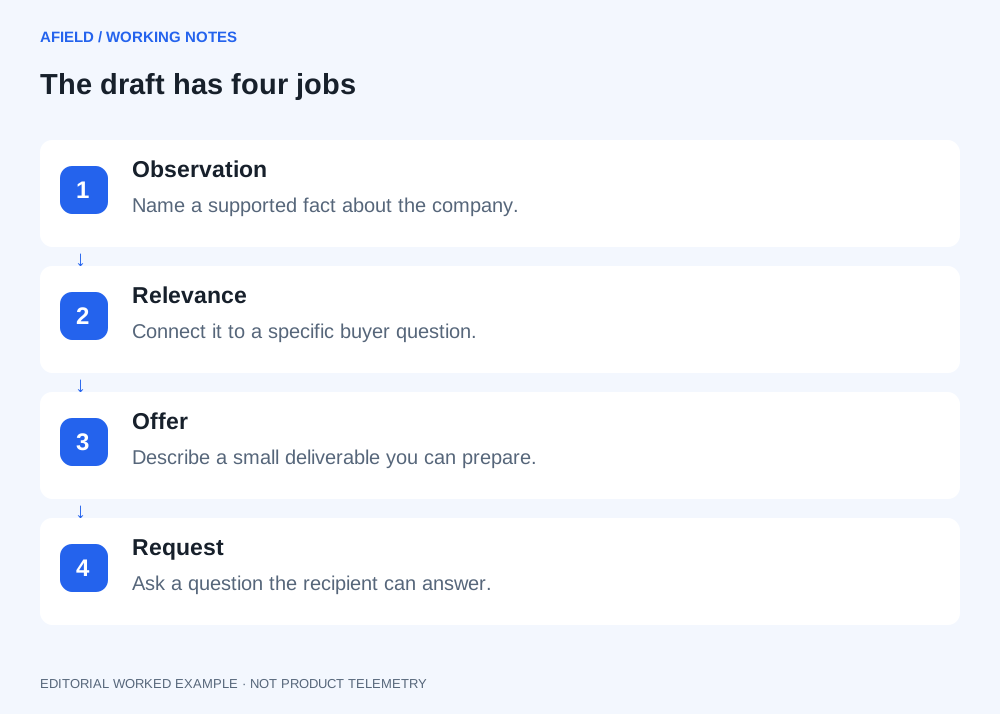
A better email starts with a fact you can defend, then offers a small output that follows from it. Here is a worked example, followed by a review process you can reuse.
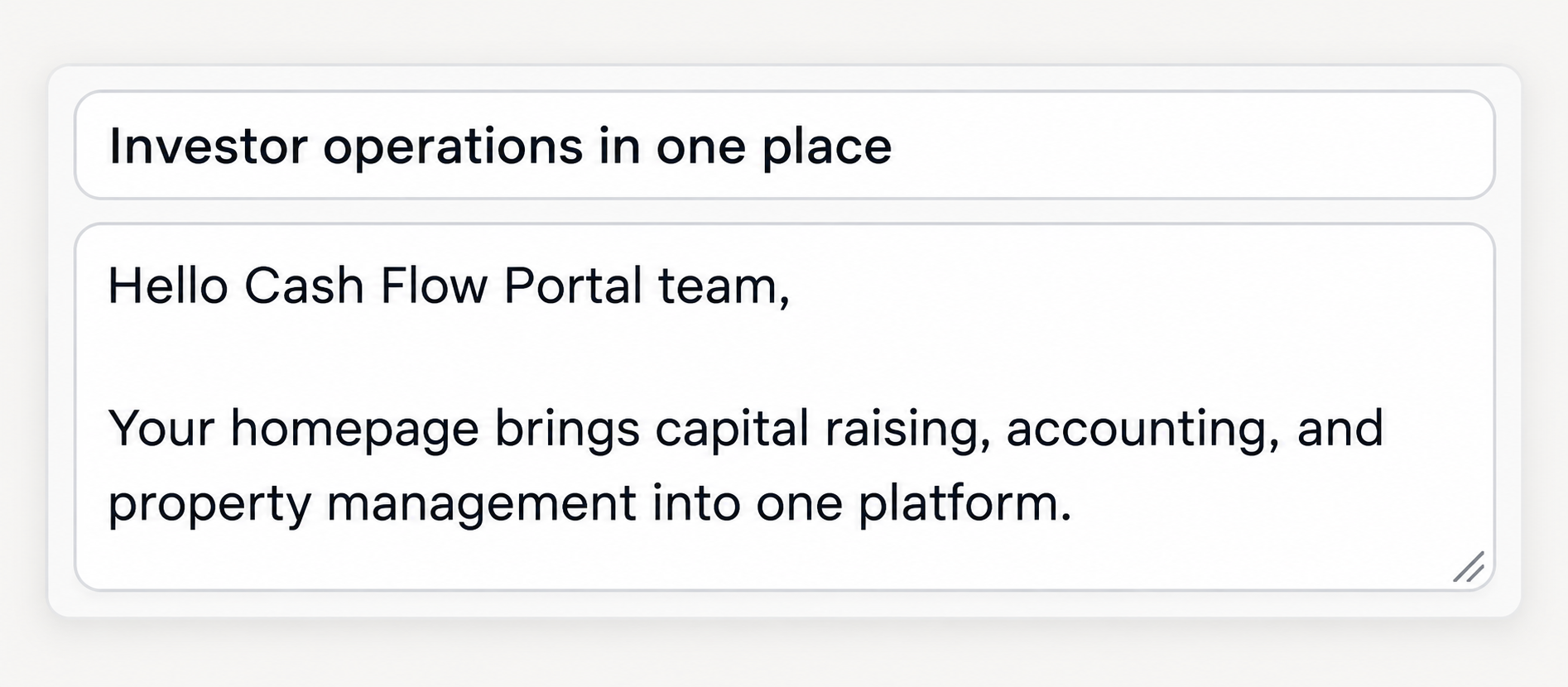 Click image for full resolution Draft editor — Click the subject or body field to edit the existing draft. Scroll inside the body field to review the whole message. The screenshot is cropped before any recipient or sender address.
The weak version
Hi team, I love what you are building. We use AI to transform marketing, save time and grow your pipeline. Our platform handles research, content and outreach. Are you available for a 30-minute demo this week?
The opening could describe almost any company. The benefits are asserted without a connection to the recipient, and the only concrete request is for their time. Adding a funding headline to the first sentence would not repair those problems.
Choose a source that supports a useful observation
Cash Flow Portal's homepage describes a platform spanning capital raising, accounting and property management. That gives us an observable product scope. It does not prove that its team is struggling to generate leads or needs marketing help. Official source
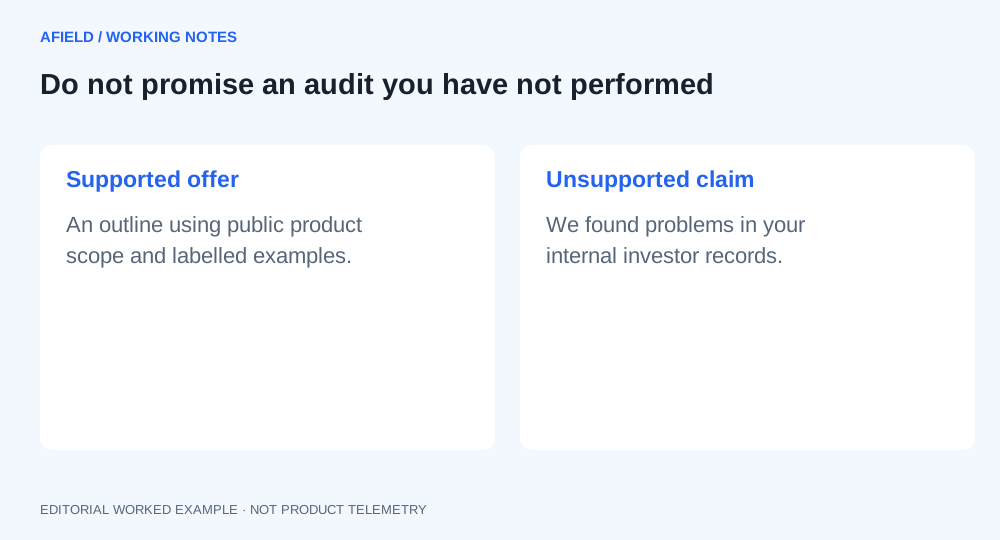
The useful buyer question is narrower: how should a general partner evaluate the consistency of investor records across those workflows? A short guide could answer that question without pretending to inspect a customer's private records.
 Click image for full resolution Source review — Expand Background and sources above the subject. Compare the opening observation with the original public product page. This card shows the retained observation; it does not establish a recent funding or hiring event.
The rewritten draft
Subject: Investor operations in one place
Hello Cash Flow Portal team,
Your homepage brings capital raising, accounting, and property management into one platform.
For GPs comparing systems, Afield could draft a short guide showing which investor records need to stay consistent from subscription through distributions and reconciliation. It would use your public product scope and clearly label example workflows, giving prospects something concrete to evaluate before a demo.
Would a one-page outline be useful?
Best,
Afield team
This illustrative draft has not been sent. It also uses a team greeting because the available contact route does not establish a specific recipient for this offer.
What changed, sentence by sentence
| Part | What it does | What it avoids |
|---|---|---|
| Product observation | Shows exactly what prompted the email | Empty praise or a fabricated pain point |
| Named audience | Identifies GPs comparing systems | An undefined “your ideal customer” |
| Small deliverable | Offers a short guide with concrete contents | A broad promise to transform marketing |
| Evidence boundary | Uses public product scope and labeled examples | Implied access to internal workflows |
| Closing question | Allows a brief yes, no or redirect | Requiring a meeting before value is clear |
The message can still be improved after a real conversation. A recipient may prefer an outreach sample to a guide, or may tell you someone else owns the topic. That feedback should change the next draft.
Use Afield to prepare, then read the exact copy
Use this company's saved sources. Draft one individual email with one
supported observation and one small output relevant to its buyer audience.
Use 70–110 words and one easy closing question. Do not claim an internal
problem, recent event or prior relationship without evidence. Draft only.
Review the resulting card in full. Open the cited page. Check whether the observation in the body agrees with the source and whether the offered output is something you can deliver. Look for an invented personal name, a guessed address presented as verified, or a claim that the work is already done.
Selected retained interface captures are AI-enhanced for clarity; diagrams are illustrations.