 Afield
In this article
A spreadsheet is often a sensible place to start. You can see each company, change a note and write the next action without configuring a new system. The case for changing it begins when the team can no longer answer ordinary questions reliably.
Which version of this draft was sent? Who owns this reply? Why was this company added? If answering those questions requires reconstructing the week from browser tabs and private messages, the process needs attention.
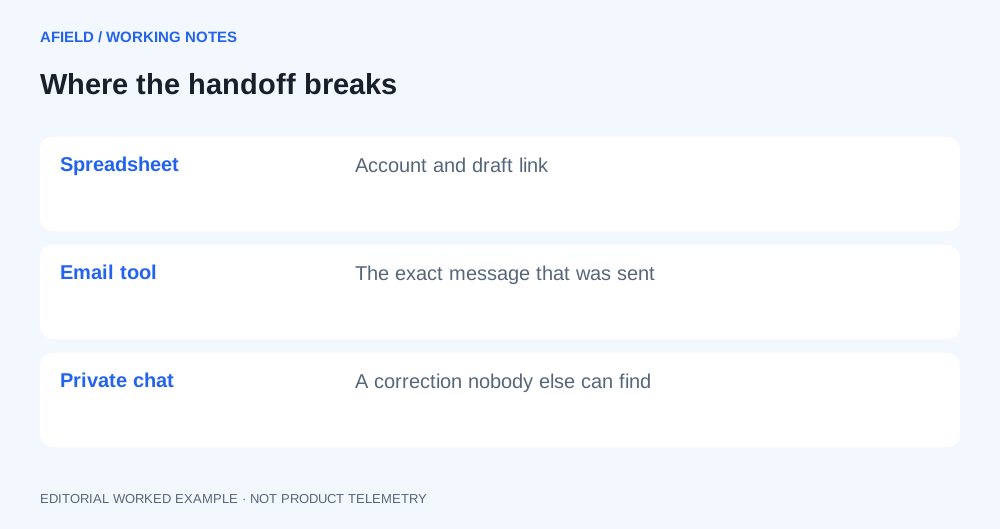
Keep a one-week handoff log
Record the interruption when it occurs, rather than estimating your savings from memory. The following entries are illustrative:
| Interruption | What was missing | Smallest repair to try |
|---|---|---|
| Two people researched the same account | A visible owner and a stable company identifier | Add the domain, owner and research date to the shared record. |
| A follow-up used an old draft | The version actually sent | Link the sent message to the account. |
| A writer could not find the source behind a claim | A link attached to the observation | Store the source beside the fact, not in a separate chat. |
Try these repairs in the spreadsheet first. If they solve the problem and the team maintains them, changing platforms may not be your most useful task this week.
Ask a new tool to resolve your real interruption
Bring one of those incidents to a product trial. Ask the operator to recover the relevant source, locate the existing draft and name the next owner. Inspect the work yourself. The useful comparison is your actual recovery process against the proposed one.
Afield's research and draft workflow is worth examining if your interruption occurs between the buyer brief, company research and a new message. If your main problem is sales ownership after replies, include the CRM and its operating process in the evaluation. A new draft generator will not settle an ownership dispute.
Account for the switch itself
List what you would move: company records, sources, draft history, sender accounts and task ownership. Check what can be transferred and what must be reconstructed. Assign a person to keep the new process current. A system that nobody maintains can become a second spreadsheet with a nicer interface.
The decision can be small. Move one campaign, retain the existing records and inspect the next handoff. Expand only after the people doing the work can find the source, the sent version and the next action without asking you.
Run one account through the proposed repair
Take a record the team already understands. A researcher has saved the manufacturer's website, a note about its equipment range and an email draft. The salesperson changes the offer before sending. In the old process, the sheet still links to the researcher's original draft.
The repair needs two separate states. Keep the editable draft as preparation, and attach a reference to the sent message once sending occurs. Record the actual recipient and the person responsible for the next action. A status cell saying “contacted” cannot tell a colleague which version reached the buyer.
Now ask someone who did not work on the account to explain the last interaction. They should be able to open the source, see the sent offer and identify the next owner. If they still need to ask the original salesperson, record exactly which part was missing. Adding another mandatory column will only help when somebody can populate it during normal work.
Keep the correction with the sent message
If the buyer says they no longer make the equipment mentioned in your email, mark the research note as superseded and attach the reply. Keep the earlier note and sent message so a colleague can understand why the email was written. Assign the person who will decide whether the account still belongs in the campaign.
A worksheet for the cost of reconciliation
Measure interruptions during ordinary work. Count the time spent recovering the missing information, not every minute spent on the account. The following fictional week shows why the distinction matters.
| Incident | Occurrences | Minutes each | Total |
|---|---|---|---|
| Recover the sent version | 6 | 8 | 48 minutes |
| Resolve duplicate research | 3 | 15 | 45 minutes |
| Find the next owner | 4 | 6 | 24 minutes |
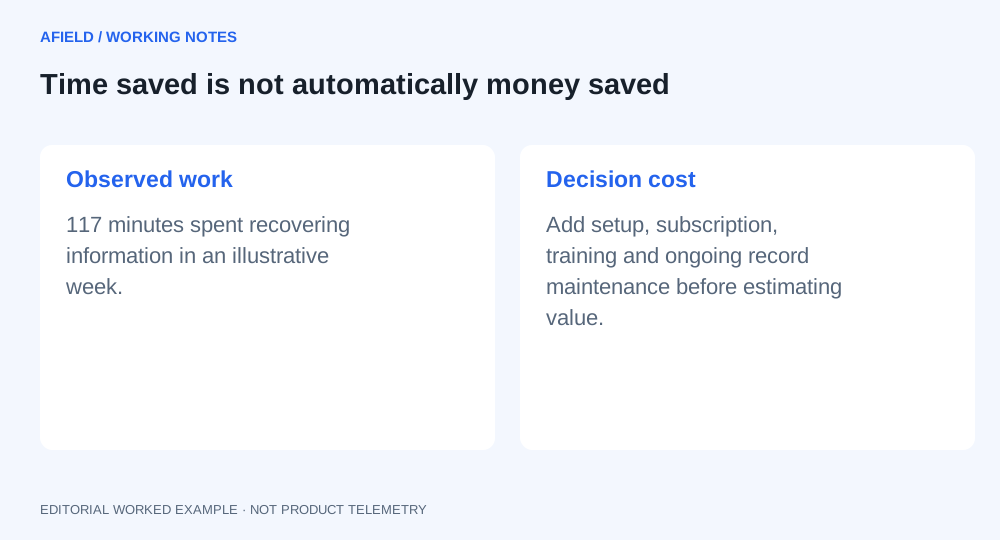
That is 117 minutes in the sample week. At an assumed internal time value of $40 per hour, the time is valued at $78. This is a planning illustration, not a salary benchmark or a promised saving. A tool will rarely eliminate every minute, and the recovered time may not translate into a lower cash expense.
Add subscription cost, initial setup, training and ongoing administration before claiming a financial benefit. Keep one-off costs separate from recurring ones. If a proposed system takes ten hours to configure, that work belongs in the decision even when the first invoice looks cheap.