 Afield
In this article
A funding headline can tell you that something happened. It does not tell you that the company needs your product, that it has a budget for it, or who should receive your email.
Signal-led prospecting works when you keep those questions separate. This guide follows the chain from an event to a company, then to a relevant proposal and a contact route.
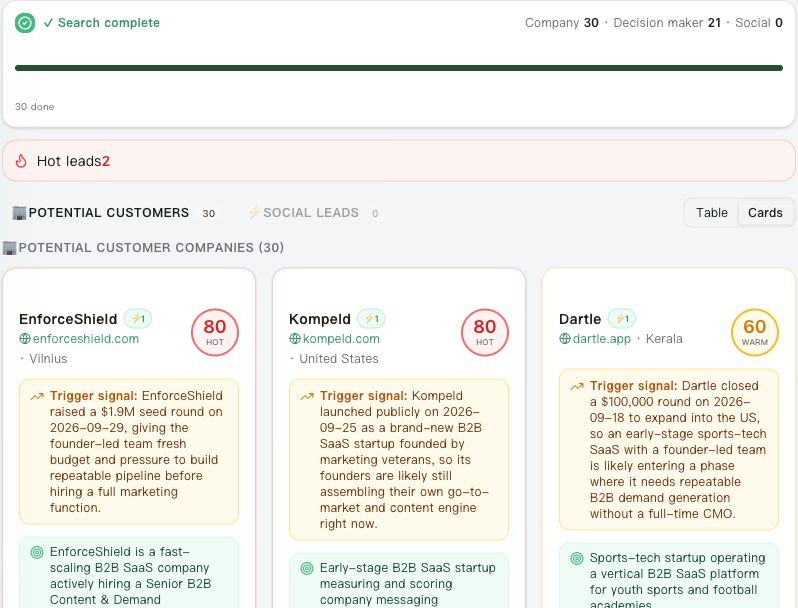 Click image for full resolution Saved company results in Cards view. Start with one company, then inspect its event and source.
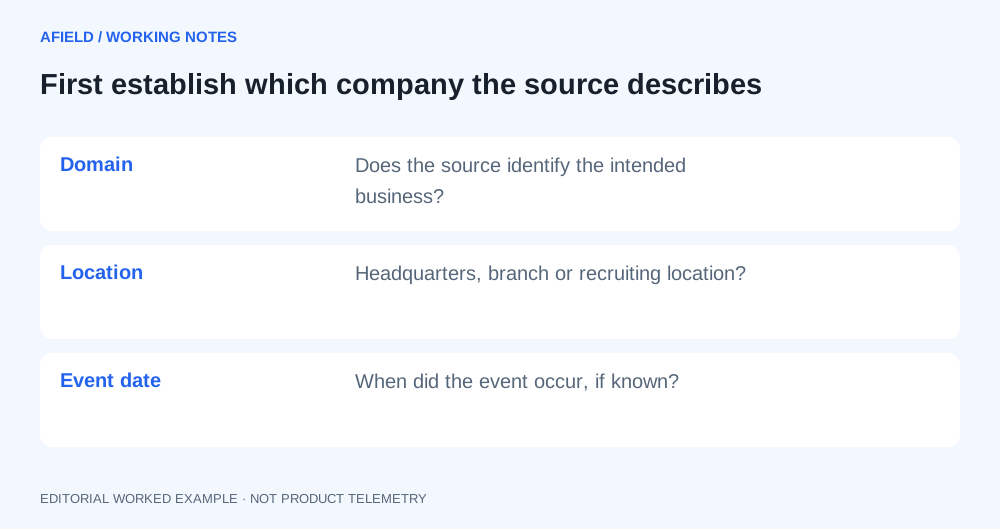
Start with the change you care about
Choose signals that have a plausible connection to your offer. An onboarding product might investigate new markets or enterprise-customer expansion. A recruiting product might look for a specific hiring pattern. The connection is a research hypothesis until the evidence supports it.
Find recent, dated public changes relevant to our saved product and buyer
profile. Start from announcements or other public signals, identify the
company involved, then check its official website for business fit.
Exclude the news publisher as a target. Keep event date and source URL.
Do not infer buying intent or budget from the announcement.
This request makes the direction explicit: signal → company → fit. It complements company-first research, where you already know the accounts and want to learn what changed.
Bind the event to the right entity
Read beyond the headline. A news page can mention the issuer, investors, partners and customers. Only one may be the organization you intend to target. Match the named company to its official domain and confirm that its description agrees with the article.
Keep the publication date and the event date distinct. A new article can discuss an old event. A homepage saying “new” without a date does not establish a 30-day signal.
| Field | What to retain | Why it matters |
|---|---|---|
| Company | Name and official domain | Avoids targeting the publisher or a namesake |
| Observation | What the source actually reports | Prevents turning inference into fact |
| Date | Event date, or explicitly labeled report date | Lets you judge freshness honestly |
| Source | The precise article or announcement | Makes the observation inspectable |
| Fit | The connection to your product | Keeps interesting news from becoming irrelevant outreach |
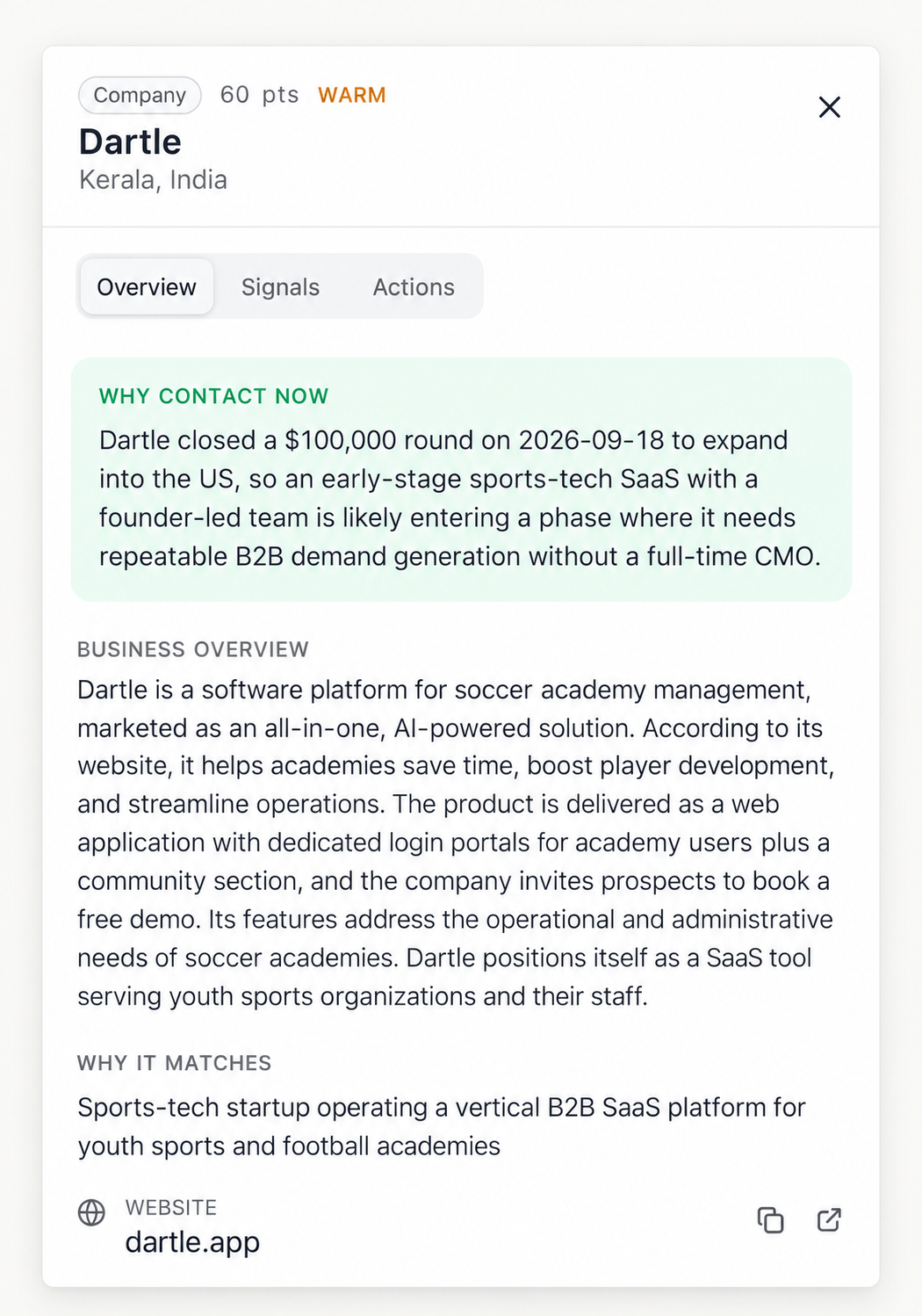 Click image for full resolution Open Expand details, then Overview. Match the product, official domain and business description to the company named in the event. A similarly named website is not enough.
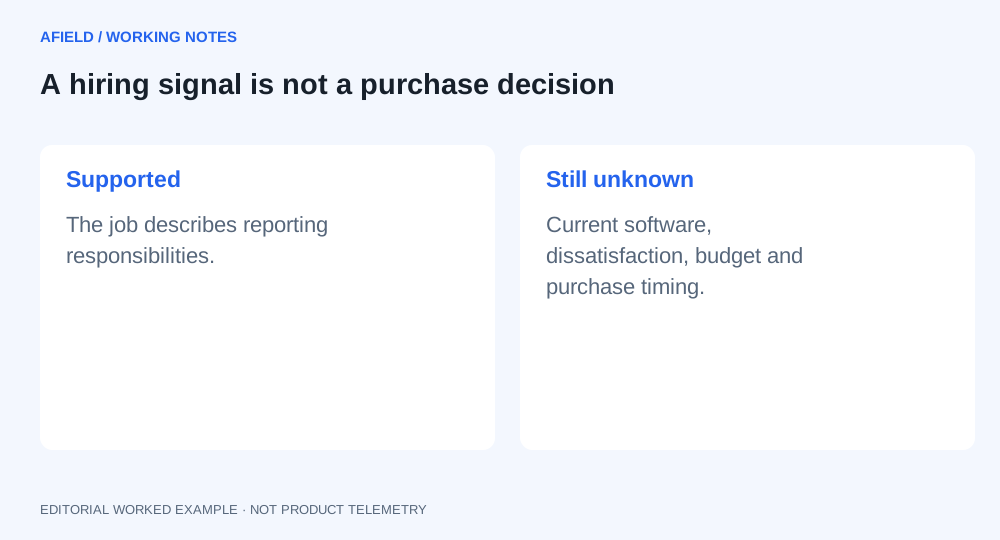
Work through one example carefully
In retained research, a 2026-09-18 Business Standard report described Dartle raising $100,000 to expand its US footprint. Its official site described software for soccer academy management. Those facts support exploring whether an academy-outreach sample could be useful.
They do not establish that Dartle needs an agency, wants cold emails or has allocated the funding to marketing. A responsible proposed task would be to research three US academy candidates with official locations and prepare an opening for each. The output is prospective work, not something already completed.
Sources to inspect: Dartle's website and the dated report.
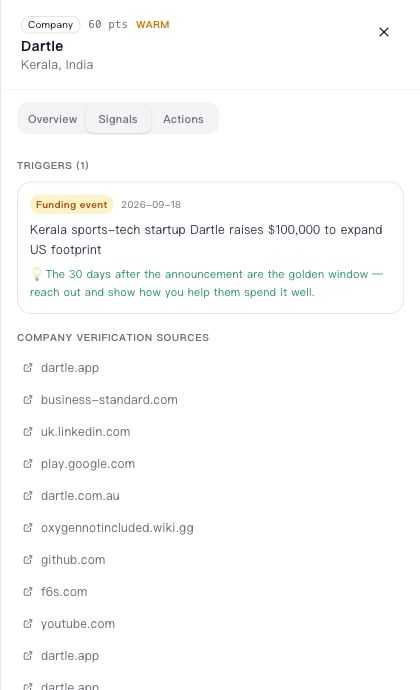 Click image for full resolution Choose Signals to inspect the event date and source links. The source list also contains unrelated namesakes: reject the game wiki, Australian site or software repository if they do not identify this sports-tech company.
Discover a contact without inflating certainty
Ask the software to find contact routes. Prefer an appropriate named person when evidence supports their role and address. A public team mailbox can be an honest fallback, but it does not become a named decision-maker because it was returned in a search.
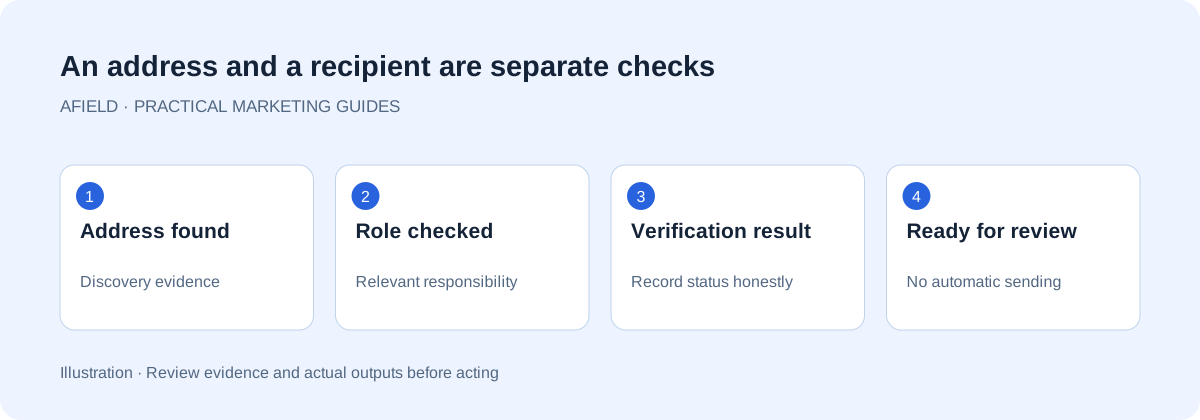 Click image for full resolution Illustration: a valid mailbox can still be the wrong recipient for your proposal.
Use explicit labels: publicly listed address, guessed pattern awaiting verification, verified mailbox result, or unresolved. Verification also has limits: a mailbox check does not guarantee inbox placement, ownership by the intended person or consent to receive a message.
The account note you can hand to a writer
| Field | Dartle example |
|---|---|
| Observed business | Soccer academy management software, as described on Dartle’s own site. |
| Reported change | Business Standard reported $100,000 in funding for US expansion on September 18, 2026. This is the report date. |
| Proposed offer | Research three US soccer academies and explain why each could fit the product. |
| Unknown | Whether the team wants this work, who owns US outreach and which academy segment it prioritizes. |
| Opening question | “Would a three-academy research sample help your US outreach, or are you focused on a different buyer group?” |
This is a proposed outreach angle; the academy sample has not been produced here.
Selected retained interface captures are AI-enhanced for clarity; diagrams are illustrations.