 Afield
In this article
A list of companies can look relevant while being unusable. “Small SaaS businesses” might include consumer subscriptions, developer tools, agencies with a software side project and companies selling to an entirely different buyer. A marketer cannot write one convincing offer for all of them.
Before the first search, write down who should not appear. Exclusions make the brief testable: another person can inspect a company and explain why it stays or goes.
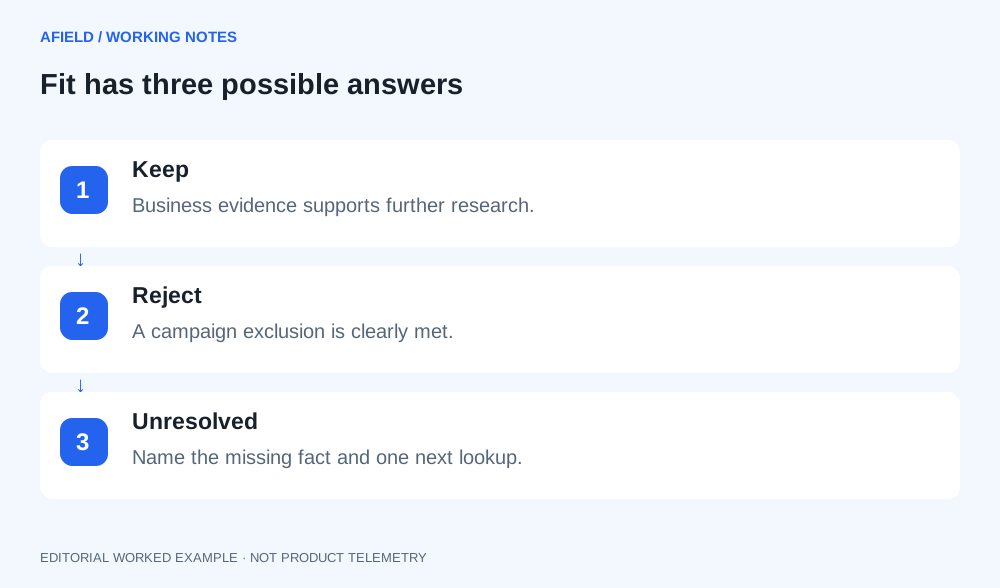
A brief with enough information to reject a company
Here is a fictional campaign for onboarding software. The seller can import reusable implementation checklists, but cannot provide bespoke consulting. That delivery constraint changes the audience.
Find B2B software companies whose customers need a repeatable implementation process. We want to discuss reusable onboarding templates with the person responsible for customer onboarding. Exclude consumer apps, consulting-only businesses and companies whose only published onboarding material concerns their own employees.
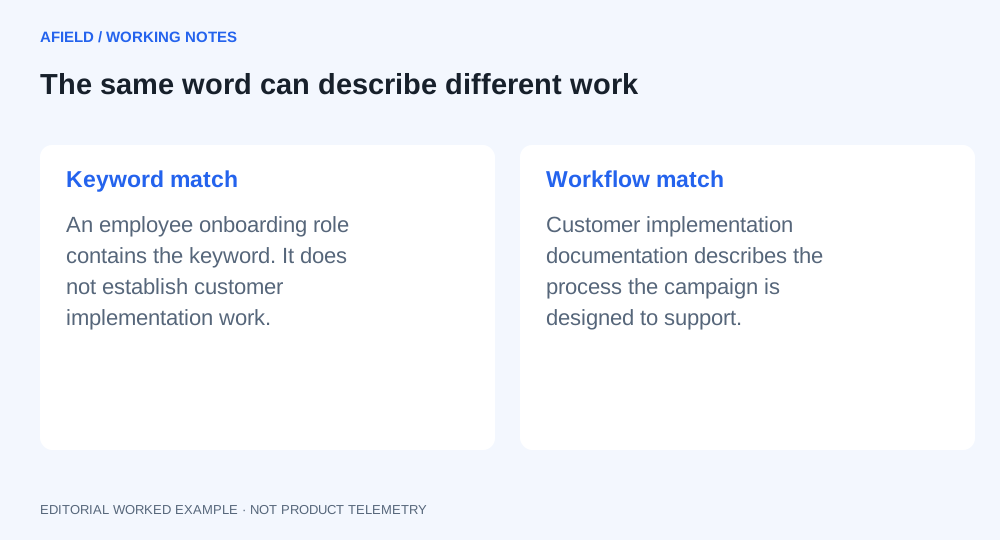
The last exclusion is easy to miss. A hiring page about employee onboarding contains the right word and describes the wrong problem.
Apply the brief to three sample records
| Illustrative website evidence | Decision | Reason |
|---|---|---|
| Consumer fitness app with a quick-start screen | Exclude | The campaign targets customer implementation in B2B software. |
| B2B platform offering an implementation checklist to new customers | Keep for research | The published workflow fits; the buyer and current need still need checking. |
| Software company advertising an employee onboarding specialist | Do not use that job as a customer-onboarding signal | The role concerns internal HR. Research the product separately. |
These are invented records to demonstrate the rule. They are not discovered leads. Notice that “keep” means investigate, not send an email immediately.
What to change when the shortlist is wrong
If every result is too broad, tighten the business definition. If the companies fit but the roles do not, fix the buyer definition. If a relevant company has no reachable contact, retain it as a research candidate rather than inventing an address.
Changing all three at once makes it hard to learn why the next result differs. Keep a brief version and record the particular rule you changed. For example: “Version 2 excludes HR onboarding pages; the offer is unchanged.”
In Afield, use the buyer brief as the checkpoint before continuing into discovery. Inspect a few accepted and rejected companies before drafting messages. Follow the first-campaign tutorial for the interface steps.
Inspect the record that sits on the boundary
A consulting firm has a product page, pricing tiers and customer login. Under the original “exclude agencies” rule, it would disappear. Under an equally careless “has software” rule, every agency with a client portal would enter the campaign. The useful question is what customers can buy and use.
Open the product page and follow the commercial path. Does the page describe a separately available tool, or is the login simply where consulting clients receive deliverables? Look at the documentation as well as the headline. An import guide written for the customer operating the software supports a different interpretation from a page saying the agency performs every step.
For the campaign in this example, retain a hybrid business only when its separately marketed product has an implementation workflow the offer can help. Record the product name and supporting page. Exclude the service-only offer, even when the parent company uses the word platform. If the commercial model remains unclear, label the record for review rather than making its name decide the classification.
Rewrite one rule and check both sides of it
Version 3: include vendors with a separately available B2B software product and a customer implementation process. A services division does not by itself disqualify the company. Exclude client portals that only deliver the vendor's consulting service. Retain the page that establishes the distinction.
Recheck an accepted company and a rejected company with this rule. The revised rule should rescue the hybrid vendor without admitting the consulting portal. If both now pass, the wording is still too broad. If both fail, the rule still relies on the company category rather than the relevant product.
Only then continue to role research. The person selling consulting and the person running the software business may be different. A more precise company list still needs a message aimed at the part of the business you selected.
Track rejection reasons before tightening the audience again
A sample audit might contain 20 reviewed records: eight accepted for research, seven rejected and five unresolved. Those are illustrative counts. They do not establish market size or the quality of a provider’s entire database. They tell you where to inspect this particular search.
| Reason in the sample | Count | Change to consider |
|---|---|---|
| Employee rather than customer onboarding | 4 rejected | Clarify which workflow the keyword refers to. |
| Consulting-only delivery | 3 rejected | Require evidence of a software product. |
| Relevant workflow unclear | 5 unresolved | Try one targeted documentation lookup. |
| Business fit supported | 8 accepted | Research role and contact route next. |
A high rejection count does not automatically mean the audience is too narrow. It might mean the original retrieval matched a word instead of a business. Conversely, a list with no rejected records may indicate that nobody applied the exclusions.