 Afield
In this article
Start with the exact missing URL and the reason Search Console reports for it. A page blocked by a response header needs a different repair from a page Google has discovered but has not crawled.
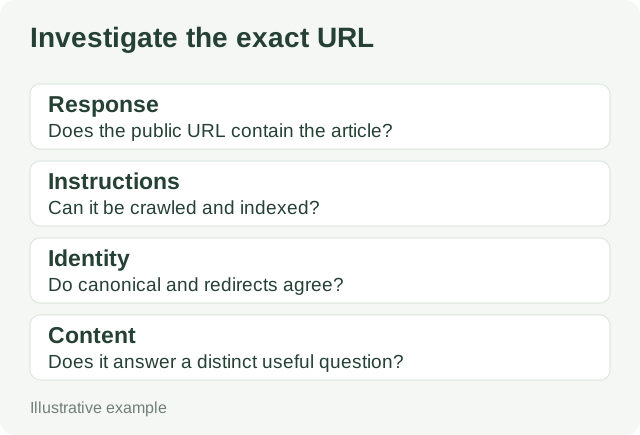
Save what the public URL returns
Open the article while signed out. For a command-line check, replace the example address below with your public URL. This downloads one page and records the redirect chain; it does not change the website.
curl --location --max-redirs 5 --max-time 30 \
  --dump-header article-headers.txt \
  --output article.html \
  --write-out 'Final URL: %{url_effective}\nHTTP: %{http_code}\n' \
  'https://example.com/blog/your-article'

grep -niE 'HTTP/|location:|x-robots-tag:' article-headers.txt
grep -niE 'noindex|canonical|<title|<h1' article.html
Read the final response block as well as intermediate redirects. Check that the saved body contains the intended article. The text search is a quick lead: a word such as “noindex” in an article about SEO is not an indexing directive. Inspect the actual meta element or header.
In Search Console, inspect that same URL. Record the indexing reason and Google-selected canonical. A live test helps inspect current access; the indexed report describes what Google previously processed. For a JavaScript page, inspect the rendered result as well as the initial HTML.
A link can exist without a path from your main pages
Fictional example: three translated articles link to each other, but no public hub links into that group. Each article has incoming links, yet a reader starting at the main site cannot reach any of them. A simple “zero incoming links” test misses this case.
Trace an ordinary HTML link path from the home page through a relevant directory to the article. If the group is disconnected, link the real translated edition from its reviewed counterpart or the relevant resource directory. A sitemap and alternate-language markup are additional discovery signals, not substitutes for a usable navigation path. Do not add unrelated links to every page.
For a translated comparison, inspect both the visible language link and the final destination. Keep the destination's language, canonical and substantive answer consistent with the label. If no reviewed translation exists, label the available English edition honestly instead.
Repair the reported cause
| Reported finding | Next check | Successful repair check |
|---|---|---|
| Redirect | Follow the destination; choose the intended canonical article. | Internal links and sitemap point directly to that URL. |
| Excluded by noindex | Inspect robots meta tags and X-Robots-Tag headers; find the template or deployment setting. | The public article loses the unintended directive; private previews retain their intended rule. |
| Alternate canonical | Compare the selected page, declared canonical and duplicate content. | These signals agree with the intended URL; do not remove a correct canonical just to raise a page count. |
| Discovered, not crawled | Check a crawlable internal link, sitemap entry and public access. | The URL is accessible and linked from a relevant page; use URL Inspection after the fix and request indexing if the live test passes and quota is available. |
| Crawled, not indexed | Read the fetched page and its nearest competing article. | The body completes a distinct reader task; use the refresh-or-retire review for this branch. |
A complete noindex example
Demo response, not a live Afield incident:
HTTP/2 200
content-type: text/html
x-robots-tag: noindex
The CMS says the article is public, but a preview deployment rule adds the header. Correct that rule only for the public deployment. Re-run the request, confirm the final response no longer contains the directive, and test a private preview to ensure its exclusion remains. Leave the article title unchanged: this was an access repair.
Google documents both meta and response-header noindex rules. Blocking crawling in robots.txt is not a way to help Google read a changed noindex rule.
Keep a four-field repair log
URL: [exact public article]
Before: [inspection date, indexing reason, selected canonical]
Change: [specific header, template, link or content correction]
After: [public response + live test date; later indexing state]
Once the corrected page is accessible, follow Google’s recrawl procedure. A request is not confirmation of indexing. For discovery issues, repair the reader’s internal-link path before submitting the same URL again.
Keep the request date separate from the indexing observation. If Search Console says the daily quota is exhausted, retain the queue and wait; do not repeatedly submit or try another account to bypass the limit. A successful request does not guarantee a crawl or inclusion in search.