 Afield
In this article
You can launch a translated blog index before translating every article. Label the article language clearly and link to the version that exists. A language switch should not promise a translated article and then land on the same English body.
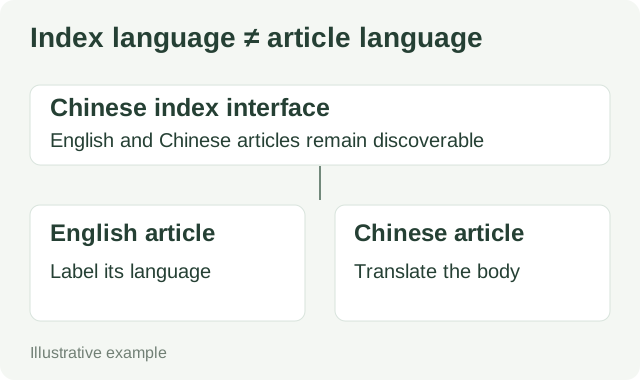
Keep the publishing status explicit
Demo release matrix: a small team has translated its navigation and is releasing Chinese articles gradually.
| Content | Available | What the Chinese index should show |
|---|---|---|
| Company-shortlist tutorial | English article only | “公司名单审核教程 · 英文” linking to the English article. |
| CSV import guide | English and reviewed Chinese articles | Chinese title linking to the Chinese guide; offer English as an alternate. |
| Onboarding checklist | Chinese draft awaiting factual review | Continue linking to the available English version. Keep the draft out of the published translation count. |
Show “2 articles in Chinese” only when two Chinese articles are published. A translated title or a short abstract does not make the full article translated. If a card contains a summary in Chinese but links to English, put the language label beside the link.
Add alternate-language markup to real counterparts
For two equivalent, published versions, both pages can include the following in their HTML head. These are illustrative addresses:
<link rel="alternate" hreflang="en" href="https://example.com/blog/import-guide">
<link rel="alternate" hreflang="zh-Hans" href="https://example.com/zh/blog/import-guide">
Google’s localized-version documentation calls for fully qualified alternate URLs and reciprocal references, including the page itself. The markup describes language variants; it does not translate the content or guarantee indexing.
Translate the procedure as well as the prose
- Run the example with the translated field labels. Preserve code identifiers that the actual product requires.
- Translate the failure message and its correction, or explain when the product displays that message in English.
- Check diagrams, image captions, downloadable files and button text referenced by the steps.
- Keep locale-specific dates, decimal separators and examples consistent with the instructions.
- Have a fluent reviewer perform the task using the translated page without consulting the original.
If the product UI is available only in English, use the actual English control name beside its explanation. Inventing a translated button label would make the tutorial harder to follow.
Handle an English update without losing track of the translation
When the import format changes, mark the Chinese procedure for an update and assign an owner. Check the sample file and rejected-row example first: those can become wrong even when the introduction still reads well. Publish the corrected version, then verify the language selector, index card and sitemap entries all point to the intended live pages.