 Afield
In this article
A manufacturer can be an excellent fit for inspection software without shopping for it. A funding announcement can be recent without changing its inspection process. Combining both into a single “hot” label hides the questions a salesperson still needs to ask.
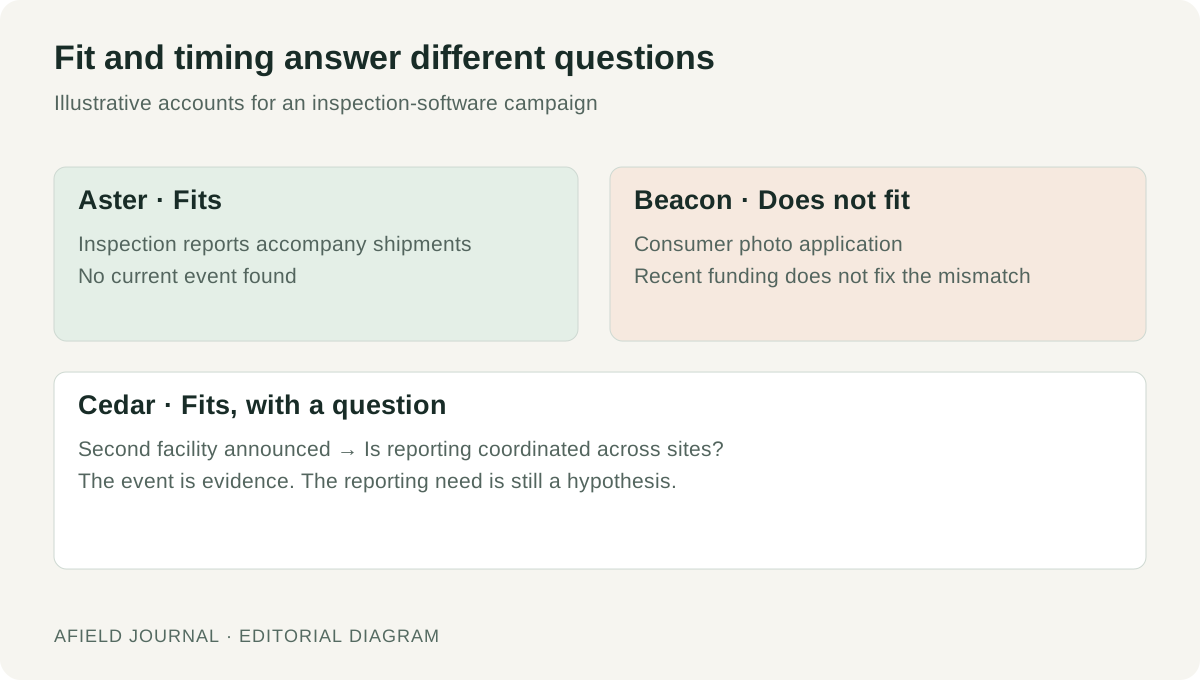
Use two columns before assigning a priority
In this fictional campaign, the seller helps component manufacturers attach inspection evidence to shipped orders. Business fit depends on the manufacturing and documentation workflow. A reason to act now depends on a change that makes that workflow relevant at this moment.
| Account | Business fit | Timing evidence | Next move |
|---|---|---|---|
| Aster Components | Publishes traceable inspection reports | No current event found | Ask about the existing handoff |
| Beacon Apps | Sells a consumer photo app | Announced funding yesterday | Reject for this campaign |
| Cedar Machining | Produces documented precision parts | Announced a second facility | Investigate whether reporting spans both sites |
These are invented accounts for explaining the method. Cedar deserves a specific follow-up, but the expansion does not prove that it has a reporting problem or a budget for your product.
Make the evidence inspectable
For fit, keep the product or service page that supports the classification. For timing, keep the dated source and distinguish publication date from event date. A story published this week may discuss an expansion completed last year.
Add an inference field: “A second facility may introduce a cross-site reporting handoff.” Then add the question that would test it: “Are inspection records reviewed centrally or by each facility?” This turns an assumption into a conversation rather than presenting it as a discovered fact.
Let the distinction change the message
For Aster, a reasonable opening is: “Your site describes inspection reports accompanying shipped parts. How does the team collect the final report before an order leaves?” It does not need an invented trigger.
For Cedar, refer to the published expansion and ask whether the workflow changes across sites. Avoid “Congratulations on your expansion—you must be struggling with reporting.” The first half may be sourced; the second is an unsupported diagnosis.
What changes when Cedar's new facility is only a warehouse?
Return to the expansion source before writing. Suppose the headline says “new facility,” but the body describes a distribution warehouse rather than a second manufacturing site. Your original hypothesis about cross-site inspection reporting is now weaker. The company may still fit because it manufactures precision parts, but the event no longer supports the same opening question.
Update the record rather than searching for another sentence that sounds like growth. Keep Cedar in the manufacturing group, remove the assumption about a second production team and ask about its existing report handoff. The result is a less dramatic account note and a more accurate message. That is a successful research correction even though the timing score might fall.
Use a reply to change the priority, not just the campaign status
Suppose Aster replies that customers rarely request reports and a subcontractor supplies them when needed. That answer may reduce the value of the account for your offer. Record the low frequency and outsourced ownership; do not keep treating the public reference to reports as strong evidence of an internal reporting workflow.
Cedar, meanwhile, might explain that two product lines maintain separate inspection records and that a quality manager is reviewing the handoff. This is more specific than the warehouse announcement. Ask what the review is trying to improve and who participates before treating it as an active software opportunity. Direct information from the conversation has changed what you know; the account record should show that change and its source.
A first message for the quiet account
For the fictional Aster account, a draft can use the stable business fact without inventing an event:
Subject: Inspection reports before shipment
Hello Aster team,
Your site describes inspection reports accompanying shipped parts. We work on the handoff between the people preparing those reports and the person approving an order for shipment.
Who gathers the final report in your process? If that sits with a subcontractor, it would help to know before I suggest an example.
The question can qualify the account out. That is useful: it prevents a public mention of inspection reports from turning into an assumed internal software need.
Review priorities without losing the evidence
If you use a score, retain the underlying columns and the explanation of each component. A high number should not erase a campaign exclusion. A company that cannot use the product stays out even if it has several recent announcements.
Revisit timing evidence more often than stable business facts. Keep the review date so an old event does not circulate indefinitely as “new.” For the initial targeting boundaries, start with the exclusion-list example. For the next step, use the contact-role worksheet rather than collecting every available address.