 Afield
In this article
“Write an engaging post about our product” leaves most of the writing decisions unanswered. The writer has to invent a reader, a problem, an argument and a reason to respond. Changing the tone will not supply those decisions.
Here is a complete worked example for a fictional onboarding software company. The drafts are editorial illustrations, not outputs from a measured model comparison.
What the vague request produces in this example
Transform your customer onboarding with smarter workflows. Save time, delight customers and unlock growth. Our platform helps your team deliver a seamless experience from day one. Ready to take onboarding to the next level?
Nothing explains what the reader can change. “Save time” and “unlock growth” also imply benefits that the brief has not supported.
The brief
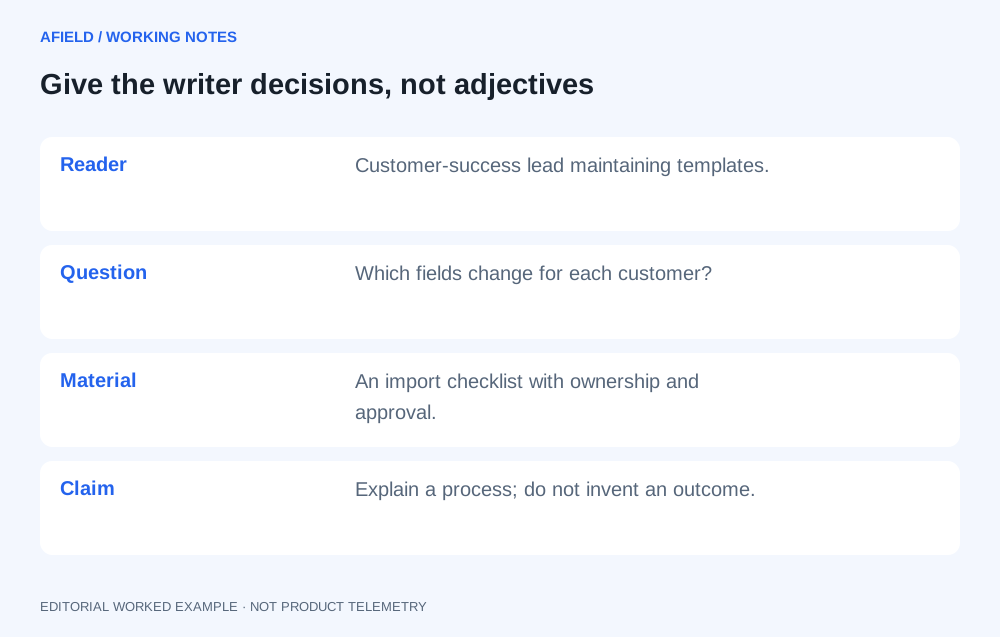
Reader: a customer-success lead who maintains implementation checklists.
Question: which fields should be reused and which must change per customer?
Argument: reuse the process; recheck owners and acceptance criteria.
Example: a data import checklist.
Evidence: an illustrative process, with no customer outcome claims.
Format: a short LinkedIn post ending with a practical question.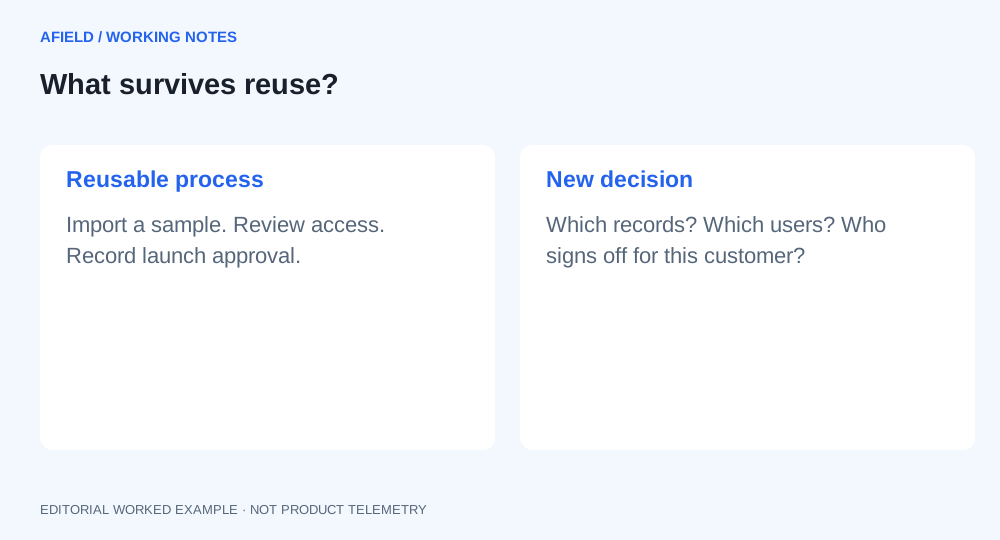
A complete illustrative draft
Before copying your last customer's onboarding checklist, check two fields: who owns each step, and what counts as complete.
A data-import step can stay in the template. The person approving the import and the checks they need may change for every customer.
Try separating the checklist into reusable steps and customer-specific decisions. Keep “import data” in the first group. Put “who signs off?” and “which records must be checked?” in the second.
Which field do you most often have to correct after reusing a checklist?
Why this draft is easier to review
The opening names a task instead of praising a platform. The data-import example shows what the distinction means. The closing question invites a relevant answer without asking for a demo. There are no invented percentages or customer results.
It is still a draft. A product specialist should check whether the example matches the team's actual process. If the product cannot represent those fields, do not attach a product promise to the post.
What happens when the reviewer disagrees with the example
The consultant reading this draft points out a problem: their clients do not decide who approves an import. The consultant owns that decision until a client administrator accepts the handoff. Simply changing “customer-success lead” to “consultant” would leave the argument wrong.
Revise the brief before asking for a new tone. The reader now needs to distinguish preparation from acceptance. Keep the same import example, but make the responsibility visible: the consultant checks the sample, the client administrator reviews the agreed records, and ownership changes only after that review. These are the agreed rules of this illustrative workflow, not features inferred from a screenshot.
Copying the checklist does not transfer responsibility.
For a data import, our consultant keeps the task until the client administrator has reviewed the agreed sample. “File uploaded” means the file arrived. “Import accepted” means someone checked the records and agreed to use them.
Put those two events on separate lines in the handoff. Name who checks the sample, what they inspect and who takes over afterward. The next project can reuse the steps; it still needs its own acceptance decision.
This revision changes the central distinction, the example and the ending together. If only the opening changed, the rest would still teach the old process. Reviewers can use that test on any AI-assisted draft: after changing a fact in the brief, locate every sentence that depends on it.
Keep the brief small enough for another writer to use
Attach the current checklist and mark the one unresolved point: whether an administrator can delegate approval. The writer can finish the supported explanation while the process owner answers that question. There is no benefit in surrounding a precise assignment with ten pages of brand adjectives.
Save the final brief beside the published version. When a later writer adapts the post into an email, they need the acceptance rule, not the discarded promise about effortless onboarding. That small piece of context does more to keep the work specific than another instruction to “sound human.”