 Afield
In this article
When an AI answer misses your product, several explanations are possible: the question describes a different buyer, the model does not recognize the brand, or the public explanation does not make a capability clear. A percentage alone does not distinguish those cases.
Afield offers two scoped ways to inspect AI answers. A fixed-question baseline asks one exact question through the answer APIs configured for the installation. A deep GEO simulation uses a generated buyer-question matrix across configured models. Both retain the returned answers; neither establishes a universal ranking across consumer AI applications.
Choose the scope before interpreting a result
| Check | What it can answer | Completion boundary |
|---|---|---|
| Fixed-question API baseline | What did each available answer API return to this exact buyer question? | One sample per configured API. Failed calls remain failed; providers that are not configured are excluded. |
| Deep GEO simulation | How do the configured models describe the brand across the generated buyer-question angles? | Successful evidence from at least six buyer angles and two configured models is required for a deep GEO conclusion. Check failed and skipped answers as well. |
A deep check with insufficient model access or successful answers returns an incomplete result. Treat the answers that do exist as scoped observations, and keep the missing coverage visible. Naming a provider in a request does not make that provider available.
Write questions that preserve the buyer’s task
For a fixed-question baseline, choose one buyer question you can interpret and keep its wording unchanged. For the deep check, review the generated questions against your category, audience and buying tasks. Category, task-specific and named-brand questions test different things, so keep their results separate. The examples below illustrate those distinctions; they are not a complete deep-check matrix.
| Question type | Illustrative question | What you can inspect |
|---|---|---|
| Category | Which tools help small B2B teams research companies and prepare outreach? | The options and selection criteria appearing in this answer. |
| Task | How can a small supplier turn company research into an individual first-contact email? | Whether the suggested workflow matches the buyer’s actual job. |
| Named brand | What can Afield do after finding a target company? | Whether the product description is recognized and accurate. |
A named-brand answer mentioning Afield is not evidence that an unbranded buyer question would surface it. Avoid combining those two tests into a headline visibility claim.
Run the simulation and retain its scope
Open the Afield assistant and adapt one of these requests. Keep the brand's official website explicit so a similarly named product does not become the subject.
One fixed question:
For [brand and official website], run a fixed-question answer-API baseline.
Ask this exact neutral buyer question: [question]. Use only the answer
APIs configured here. Return each original answer, test date, actual API
method and available citations. Separate mention, citation and recommendation.
Keep failed calls visible and do not count absent providers as zero mentions.
A deeper check:
Run a deep GEO answer simulation for [brand and official website].
Our product category and buyer are [category and audience]. Show the
buyer-question matrix, actual configured models and original answers.
Separate neutral recommendation questions from named-brand understanding.
Identify failed or missing coverage before drawing a conclusion.
Keep the wording, actual model or API method, and run date with the result. Read the answer itself, not just an extracted mention. A brand can be named while its capabilities are described incorrectly. Conversely, an answer may explain the right workflow without naming any products.
The deep simulation and fixed-question APIs use different methods. Retain the method reported with each answer, including search assistance when present. An API response is not a browser recording of a consumer assistant. If you also inspect a consumer application, record it separately with its settings and date.
Turn one answer problem into one content decision
Practice scenario: suppose a returned answer describes a product as finding companies but says nothing about preparing editable email drafts. This is a hypothetical answer gap, not a measured Afield result.
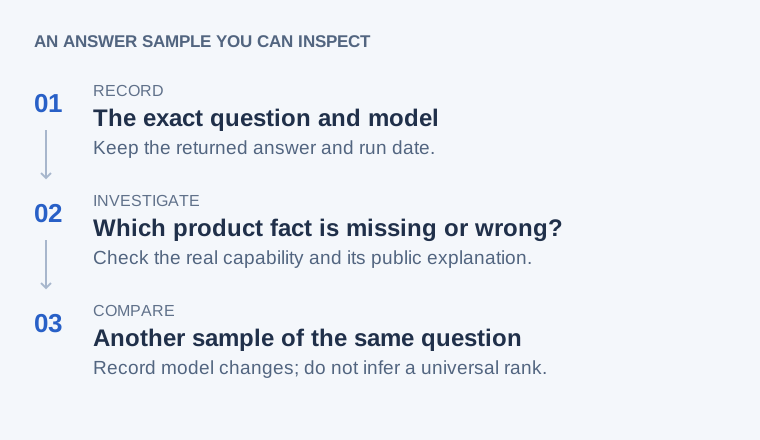
First confirm the capability in the product. Then inspect the relevant public page: does it show the actual draft, explain how research carries into the message and link to the procedure? If the page only says “accelerate your growth,” replace that phrase with the workflow and an inspectable example.
After selecting a company, continue in the same conversation to prepare a first-contact email. Ask for a subject and complete body, check the company observation against its source, then revise the draft. Sending requires a connected mailbox and review of the final message.
That replacement answers a specific product question. Support it with the real procedure or clearly labeled example, such as the research-to-email walkthrough. Do not add a capability merely because it would make a model answer more attractive.
Compare another sample without overstating it
After the public page is updated, compare only answers with the same question wording, method and model. A fresh deep run may generate a different question set; inspect it before treating the results as a before-and-after comparison. If the model or question changes, mark the comparison accordingly. Answers may vary, and publishing text does not guarantee that the next answer will use it.
| Observation | Reasonable conclusion |
|---|---|
| The model names the brand once. | The brand appeared in that recorded answer. |
| The product description becomes more accurate. | This sample describes the capability better; inspect the wording and any sources. |
| The question fails to return an answer. | The measurement is unavailable for that question. |
| The website audit passes. | The checked page signals passed; this does not demonstrate an AI citation. |
Download the answer-review worksheet (CSV). Record questions, model, answer excerpts, checked source URLs, content decisions and comparison notes. The sheet is blank so your actual observations remain distinguishable from this tutorial.
Use Search Console for observed Google queries, clicks and page performance, and the page-audit procedure for technical findings. These are complementary evidence sources with different meanings.