 Afield
In this article
Buyers do not always describe a problem using the category name on a vendor’s website. A founder may search for “voice clone detection for MSPs,” while a help-desk operator asks how to verify a caller requesting a password reset. The second discussion can be valuable research, but it is not automatically evidence that someone wants to buy the first product.
This article follows that distinction through a real public thread. The purpose is to improve a marketing research question, not to recommend a security procedure from anonymous comments.
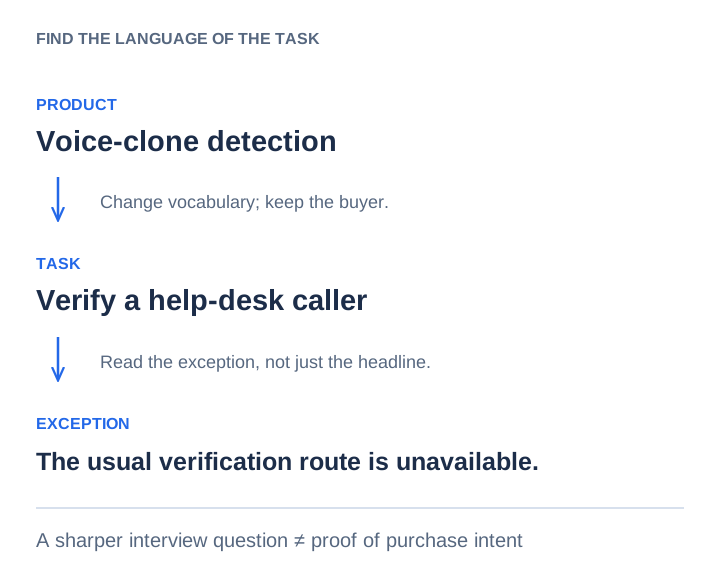
Start with the job behind the product name
Write the initial assumption explicitly: “An MSP help desk needs to decide whether to authorize a sensitive account change requested over the phone.” This gives the search something to retain when the product terminology fails.
| Search angle | Query to try | Evidence you are seeking |
|---|---|---|
| Product category | site:reddit.com/r/msp "voice cloning" | Practitioners discussing the named technology, separated from promotion. |
| Routine task | site:reddit.com/r/msp "verify" "caller" | A description of how the help desk checks a caller today. |
| Specific exception | site:reddit.com/r/msp "password reset" "phone" | What happens when the ordinary verification route is unavailable. |
These queries are a search plan, not a controlled experiment or a claim that the first query returns zero. Results vary by engine and date. During the review for this article on October 11, 2026, a task-oriented search surfaced the thread below. Keep the actual query and source URL in your notes so another researcher can revisit the selection.
Read a whole exchange, then write the finding
In “How can we ID people who call our support line for password resets?”, the author describes writing an internal caller-verification procedure. Replies discuss callbacks, self-service resets and verification products. The conversation also raises exceptions involving lost or replaced devices and the availability of a trusted contact.
The thread includes vendor participation. That matters: a product recommendation by its representative has a different evidential role from an operator describing their own process. Preserve that distinction when extracting notes. The public conversation supports a research question about account-recovery procedures; it does not establish the effectiveness of the proposed methods or demand for voice-clone detection.
A useful extraction is short enough to inspect:
Source: r/msp thread 1b2ejhm
Reviewed: 2026-10-11
Context: A support team is writing a caller-verification procedure.
Research question: What happens when the caller cannot use the usual verification route?
Retain: The task, exception and differences between participants' roles.
Do not infer: Purchase intent, market size or a verified security outcome.
Next evidence: A first-hand account of the last difficult recovery request.
The last line turns reading into a next research step. It is more useful than a sentiment label such as “high pain,” because it tells the interviewer exactly what remains unknown.
Use an authoritative source for a different question
A community post can show how people talk about a job. An incident advisory can establish that a threat pattern has been documented. Those are different contributions.
The July 29, 2025 joint Scattered Spider advisory published by the FBI describes social engineering of help-desk staff to reset passwords or MFA tokens. This provides a documented reason to investigate account-recovery processes. It does not demonstrate that the Reddit participants experienced that attack, or that a particular detection product would have prevented it.
Keep the advisory and the thread as separate entries in the research record. Combining them into “MSPs are actively buying voice-clone detection because of Scattered Spider” would add a purchase claim that neither source establishes.
Separate three kinds of evidence before writing outreach
| Evidence type | What belongs here | What you can do with it |
|---|---|---|
| Problem context | A practitioner describes a task, workaround or exception. | Choose interview questions and useful explanatory content. |
| Documented risk | An attributable advisory or incident report describes a threat pattern. | Explain why the task merits attention, within the report’s scope. |
| Purchase evidence | A person explicitly seeks a supplier, compares options or states a buying requirement. | Assess a relevant offer, without inventing budget or timing. |
The material above supplies the first two categories. We did not establish the third from this example. That does not make the research useless: it changes the next action from a sales claim to a more precise question.
Write the report someone else can use
We found a public MSP discussion about verifying password-reset callers, including exceptions where the usual verification route is unavailable. A separate joint advisory documents help-desk social engineering as an attack pattern. These sources justify further research into account-recovery procedures. They do not show willingness to buy a voice-clone detection product.
Next interview question: “Walk me through the last recovery request where the caller could not use the normal verification method. Who made the decision, what evidence was available, and what happened next?”
Then ask about the consequence without putting an answer in the participant’s mouth. Did the case wait for an authorized contact? Was the request declined? Did it expose an undocumented exception? Ask what was recorded and who owned the follow-up. Each answer can lead to a different product or content decision.
If you prepare an email, refer to the work the recipient actually owns. Do not tell an unrelated MSP that it has suffered an attack because another organization appears in an advisory. A process question can be relevant without pretending to know a private incident.
Know when broadening has stopped helping
Stop expanding the search when the retained material no longer concerns your buyer’s task. A celebrity deepfake story may mention voice cloning but reveal little about an MSP’s account-recovery workflow. More links are not better if each requires a larger inference.
At that point, record the search boundary and move to first-hand interviews or a narrower content brief. Keep source URLs and attribution in a source ledger, and use the last-incident interview script to fill the missing evidence. An honest, well-bounded research note is more actionable than an inflated demand report.