 Afield
In this article
A company announces an expansion. That gives you a reason to investigate, but it does not tell you which supplier it needs, whether a budget exists or who makes the decision. The useful work is connecting the event to your offer without skipping those unknowns.
Use this procedure for a defined account list. It produces a research note and a relevant question, not a list of companies declared ready to buy.
Choose the signal that relates to your offer
A packaging-component supplier and a customer-success software company should not use the same trigger list. For the supplier, a new production line may justify investigating the machinery and qualification process. For the software company, hiring implementation managers may justify asking how the team assigns work.
| Public event | What it establishes | What to investigate |
|---|---|---|
| Funding announcement | A financing event was reported. | What plans did the company actually name? Does one involve your product category? |
| New facility or regional expansion | A location or market move was announced. | Is the site operating, planned or delayed? Which team owns the relevant work? |
| A cluster of job openings | The company advertised those roles when observed. | Are the roles still open, and do their responsibilities describe a problem your offer addresses? |
| Product launch or leadership change | A product or role changed. | Which customer or operational process changes with it? The announcement alone may have no relevance to your offer. |
Ask Afield for event evidence before a message
For these target companies [list], research public expansion and hiring
announcements relevant to our [specific offer]. Use the last 90 days.
Keep the original source URL, publication date and event date when known.
Separate the observed event from our hypothesis about need. Show missing
evidence and suggest one question. Do not contact anyone.
Use the company’s announcement, current careers page or an attributable original source when available. Check the event date as well as the page date: a recently updated article can describe an old expansion. A missing date should remain missing. Follow the original link before treating a search snippet as evidence.
If the search returns nothing relevant, retain that outcome for the selected period. Expanding the time window is a different search; do not silently describe an older event as recent. An undated hiring page can support role research, but it cannot establish when the hiring began.
Read the gap between event and need
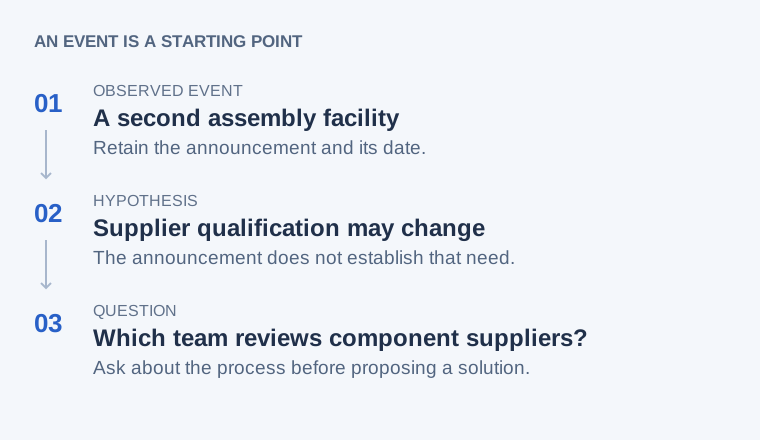
Fictional practice note: Demo Packaging has announced a second assembly facility. In this scenario, the announcement identifies a planned opening month but says nothing about outside machining suppliers.
Observed: a second assembly facility is planned.
Relevance: our offer concerns custom machined components used in packaging equipment.
Unknown: whether the new site will qualify component suppliers separately or use the existing purchasing team.
Research decision: identify the public purchasing route and ask about that process. Do not claim a supplier shortage.
This is enough to prepare a careful question. It is not enough to write “You need new suppliers after your expansion.” Keep the company on a timing-research list until the missing link is resolved.
Write the email around the unresolved decision
The following is a complete illustrative draft for that fictional company. Replace the event with a checked source and the offer with your real capabilities.
Subject: Component qualification for the new assembly site
Hello Demo Packaging team,
I saw your announcement about a second assembly facility. We supply custom machined components for packaging equipment.
Will component-supplier qualification for the new site run through your existing purchasing team? If useful, I can send our capability sheet for an initial fit check.
If another team owns this, could you point me to the right route?
Best,
[Name]
A reply naming the owner changes the next task to contact research. A reply saying the site uses existing suppliers changes the timing decision. No reply is simply no recorded reply; it does not confirm the need.
Keep a record you can revisit
Download the signal-review worksheet (CSV). It includes one clearly labeled fictional example and a blank row. For actual accounts, retain the source, observation date, event date, fit hypothesis, unanswered question and next action together.
In Afield, continue in the same conversation and open the available saved result from task history. For the next step, use decision-maker research. If the company itself may not fit, return to company discovery before writing another message.